
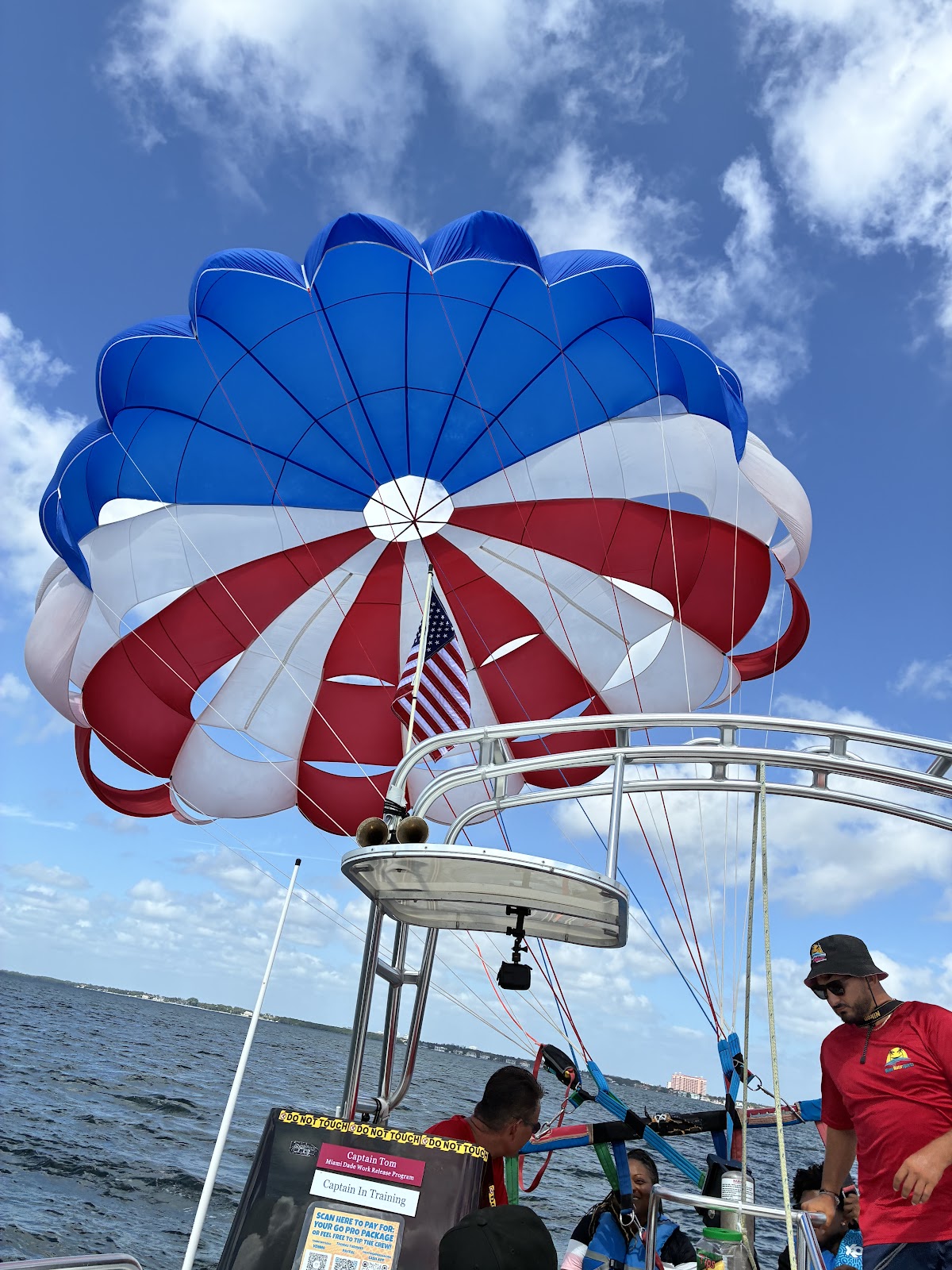
The history of parasailing in Miami begins decades ago, when the modern parasail evolved from an aerial-research curiosity into one of the most accessible thrill experiences on the water. Today in Miami, parasailing is a polished, family-friendly activity: riders launch dry from a winch boat's flight deck, climb up to 400 feet over the protected waters of Biscayne Bay, and float for roughly 6 to 10 minutes on a trip that lasts about an hour. This guide walks through how the sport got here, why Coconut Grove and Dinner Key Marina became Miami's natural parasailing hub, and what a flight over the bay actually looks and feels like.
Key Takeaways
- Parasailing descends from mid-20th-century experiments with the parachute and the "parasail wing," which was later adapted for recreation by towing a canopy behind a boat instead of a vehicle on land.
- The single biggest safety advance in the sport's history was the move from beach- and water-based launches to the boat-mounted winch system, which lets riders take off and land dry directly from the boat's flight deck.
- In Miami, parasailing matured fastest on Biscayne Bay out of Coconut Grove, where calm, sheltered water and steady sea breezes are better suited to consistent flights than the crowded open-ocean South Beach side.
- Modern Miami parasailing accommodates solo, tandem, and triple flights; the minimum age is 5, the maximum combined weight is 450 pounds, and swimming is not required because the takeoff and landing happen on the boat.
- Weather is the deciding factor: lightning always grounds flights, while light rain usually does not, and operators rely on official marine forecasts before going out.
- At Miami Watersports, weather or operational cancellations are handled with a marina credit that is valid for 2 years, rather than a cash refund.
From Parachutes to the Parasail Wing: The Origins of the Sport
Parasailing did not start as a beach attraction. Its lineage runs back to the parachute, and to mid-20th-century efforts to make a person ascend in a controlled, repeatable way rather than descend from an aircraft. The breakthrough was the parasail wing (sometimes called the ascending parachute or parawing): a specially shaped canopy designed to lift a rider into the air when towed forward against the wind.
Early versions were towed behind vehicles on land or off platforms, with the canopy generating lift as speed increased. It was a clever inversion of the parachute's purpose. Instead of slowing a fall, the wing created a controlled rise. Once engineers and recreation pioneers realized the same principle worked beautifully behind a boat over open water, parasailing as we recognize it today began to take shape.
The early water-based version was simple and a little rough around the edges. A rider was harnessed to the canopy, the boat accelerated, and the wind did the rest. Launches and landings often happened from a beach or directly in the water, which meant getting wet, timing the run carefully, and a fair amount of trust in the boat captain. It was thrilling, but it was not yet the refined, accessible experience that families line up for in Miami today.
Why Coastal Resorts Adopted It First
Because parasailing needs open water, a towing vessel, and reliable wind, it spread first through warm-weather coastal destinations where boats, beaches, and tourists all came together. Tropical and subtropical resort areas were natural early adopters. The sport offered something rare: a genuine aerial thrill that an ordinary visitor with no training could safely try in an afternoon. That accessibility is the through-line of parasailing's entire history, and it is exactly what makes Miami such a strong fit.
The Winch Boat Revolution: Dry Takeoffs and Landings
If there is one chapter in the history of parasailing in Miami that matters most to the modern rider, it is the arrival of the winch boat. This is the innovation that transformed parasailing from a wet, beach-launched stunt into the smooth, controllable, family-grade experience available on Biscayne Bay today.
A winch boat carries a hydraulic or electric winch mounted on a raised platform at the stern, often called the flight deck. The towline spools out from the winch, so the canopy can be paid out slowly and reeled back in with precision. The practical effect is enormous:
- Riders are clipped into the harness while standing on the flight deck.
- The boat eases forward, the winch lets out line, and the rider lifts off the deck gently. No running start, no splashdown.
- At the end of the flight, the winch reels the line back in and sets the rider right back down on the deck, dry.
This dry takeoff and dry landing is why parasailing in Miami is so approachable. You do not need to be a strong swimmer. You do not need to manage a beach launch or get dunked in the bay. The whole flight is bookended by a controlled departure and return from a stable platform. It also gives the crew fine control over altitude, which is how riders can be lifted up to 400 feet and then brought back down smoothly.
The winch system is also the reason solo, tandem, and triple flights all became routine. Because the line length and ascent rate are controlled mechanically, the crew can manage the lift whether one rider or three are in the harness, as long as the combined weight stays within the limit. You can see how this plays out for current flights on the parasailing activity page.
Why Biscayne Bay and Coconut Grove Became Miami's Parasailing Home
Miami has miles of coastline, but not all of it is equal for parasailing. The sport's local history is, in large part, the story of operators gravitating toward the water that works best: the protected expanse of Biscayne Bay, launched from Dinner Key Marina in Coconut Grove.
Calm, Sheltered Water Versus the Open Ocean
The Atlantic side off Miami Beach is iconic, but it is also exposed. Open-ocean swell, heavier boat traffic, and busier launch corridors make for a choppier, more crowded experience. Biscayne Bay, by contrast, sits behind barrier islands and is comparatively sheltered. The water tends to be flatter, the ride smoother, and the scenery more varied, because you are flying over a bay framed by the Miami skyline, the Coconut Grove shoreline, and the islands of the bay rather than staring at empty open water.
That calmer water is not just more comfortable. It is safer and more consistent for the winch-launch process, which is part of why parasailing operations took root on the bay side. Dinner Key Marina, at 3400 Pan American Drive, became a logical launch point: an established, well-protected marina with direct access to the open bay and the steady afternoon sea breeze that parasailing depends on.
The View From 400 Feet
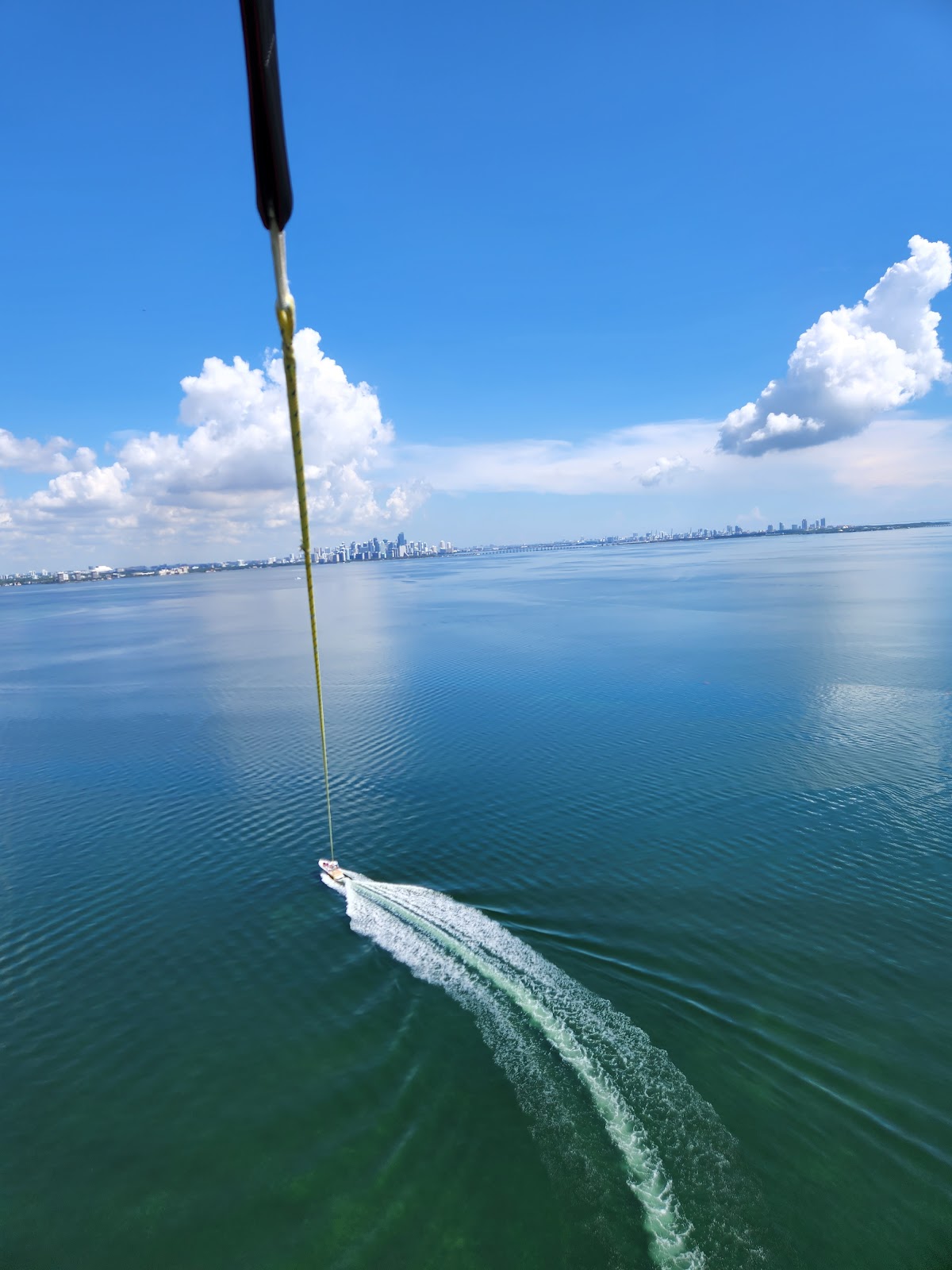
From up to 400 feet over Biscayne Bay, the perspective is unlike anything you get at sea level. On a clear day you can take in the downtown Miami skyline, the green sweep of Coconut Grove, Key Biscayne, and the patchwork of blues and greens that make Biscayne Bay's shallows so distinctive. The bay is also part of one of South Florida's great natural systems. The nearby protected waters of Biscayne National Park underscore just how rich and varied this marine environment is, with seagrass flats, mangrove shorelines, and clear water that, from above, reads almost like a living map.
This combination of skyline, shoreline, and open bay is the visual payoff that made Coconut Grove parasailing distinct from the rest of Miami. It is a calmer, more scenic, more photogenic version of the sport.
How the Modern Miami Parasailing Experience Came Together
Pull the threads together, parasail wing, winch boat, calm bay, sheltered marina, and you get the experience offered today. It is worth describing it concretely, because the modern format is the product of every historical improvement layered on top of one another.
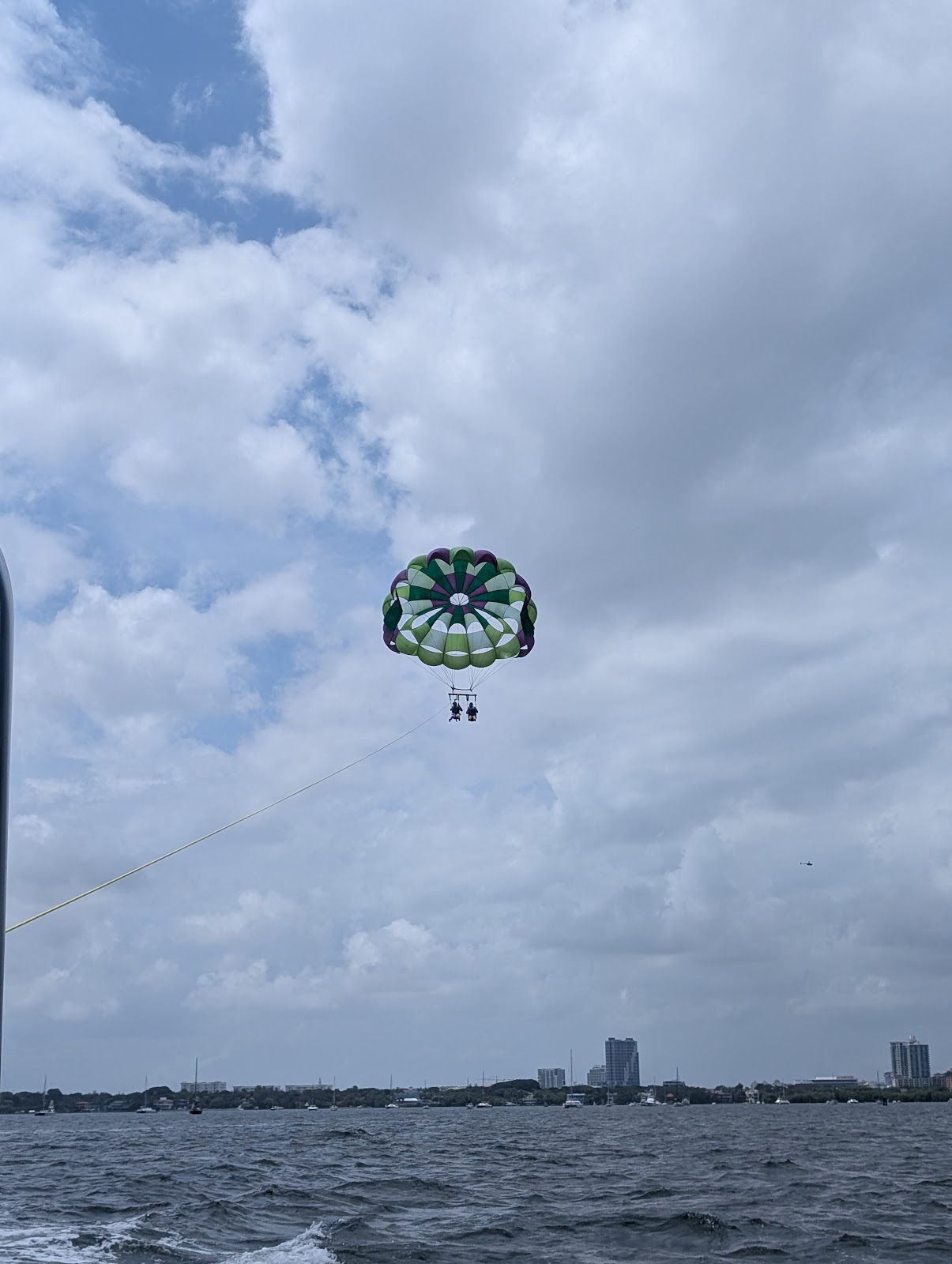
A typical trip runs about an hour from dock to dock. After a safety briefing, the boat heads out from Dinner Key Marina into the open bay. When it is your turn, you are harnessed in on the flight deck, the winch pays out the line, and you lift off without ever touching the water. You spend roughly 6 to 10 minutes aloft, climbing up to 400 feet, before the crew reels you back down to the deck. Other riders fly during the same trip, which is part of what makes it such a sociable, group-friendly outing.
Solo, Tandem, and Triple Flights
One of the quiet evolutions in the sport is flexibility. Modern Miami parasailing supports flying alone, as a pair, or as a trio, all under the same boat and crew. Tandem and triple flights are popular with couples, friends, and families who want to share the moment side by side. The governing constraint is the maximum combined weight of 450 pounds across everyone in the harness, which the crew checks before assigning flights.
Who Can Fly
Accessibility has always been parasailing's defining trait, and the modern rules reflect that. The minimum age is 5, and because takeoff and landing happen dry on the boat, swimming is not required. That last point surprises many first-timers and is a direct dividend of the winch-boat era. The activity is open to people who would never consider a watersport that involved jumping into the bay. If parasailing whets your appetite for the water, it also pairs naturally with the rest of the lineup, from a jet ski rental to a speed boat ride on the same bay.
Safety, Weather, and the Science of When Parasailing Runs
No honest history of parasailing in Miami is complete without the safety story, because the sport's reputation, and its modern rulebook, were shaped by hard-won lessons about wind, weather, and equipment.
Weather Is the Gatekeeper
Parasailing lives and dies by conditions. The single firmest rule is simple: lightning always grounds flights. There is no version of a thunderstorm where it is acceptable to put a rider on a line 400 feet in the air, and reputable operators do not bend on this. Light rain, on the other hand, usually does not stop a trip. A passing shower over the bay is common in summer and rarely a safety issue on its own. Wind is the other key variable: parasailing needs enough breeze to generate lift but not so much that gusts become unpredictable.
Operators in Miami plan around official marine forecasts rather than guesswork. The National Weather Service – Miami office issues the marine and thunderstorm guidance that governs whether boats go out, and afternoon storms are a well-known feature of the South Florida summer. Checking real-time conditions is part of every responsible operator's pre-trip routine.
The Rules of the Water
Parasailing also sits inside a broader framework of boating safety and regulation. Towing vessels and their crews operate under U.S. and Florida boating rules, and the underlying culture of safe boating draws on guidance from the U.S. Coast Guard's boating safety program and Florida's own Fish and Wildlife Conservation Commission boating and waterways resources. Florida also maintains formal boater education and vessel-safety standards through the Florida Department of Highway Safety and Motor Vehicles. For visitors who want to understand the safety side more deeply, the BoatUS Foundation's expert advice library is a solid, plain-language resource.
The takeaway for a rider is reassuring: parasailing's modern format, dry launches, controlled winch ascent, weight limits, weather holds, exists precisely because the industry standardized around these practices over the sport's history.
What Happens If Weather Cancels Your Trip
Because Miami weather can turn, the practical question every customer eventually asks is what happens if a trip gets called off. At Miami Watersports, weather or operational cancellations are handled with a marina credit that is valid for 2 years. There are no cash refunds; instead, you keep a credit you can use whenever you come back. It is a customer-friendly answer to an unavoidable feature of subtropical boating, and it means a stormy afternoon never costs you the experience, only the timing.
Seasons on Biscayne Bay: The Best Time to Fly
Part of understanding parasailing in Miami is understanding the local calendar, because the bay behaves differently through the year.
- Winter and early spring bring Miami's most reliably pleasant flying weather: lower humidity, frequent clear skies, and excellent visibility for those skyline views. Cold fronts can occasionally bring brief windy spells, but settled, sunny days are common.
- Late spring and early summer offer warm water and long daylight, with mornings often the calmest part of the day before afternoon heat builds.
- Summer is peak storm season. Mornings are frequently beautiful, but afternoon thunderstorms are routine, which is exactly why operators watch the forecast closely and why the no-lightning rule matters most in these months. Booking earlier in the day improves your odds.
- Fall can be excellent between weather systems, with warm water and fewer crowds, though it overlaps with the broader Atlantic storm season and benefits from flexible timing.
Across all seasons, the sheltered nature of Biscayne Bay is an advantage. Even on breezier days, the bay tends to stay more workable than the open Atlantic, which is one more reason the Coconut Grove launch point has endured as Miami's parasailing home.
Member Rate Versus Non-Member Rate: How Pricing Works
Like a hotel that quotes a member rate alongside a standard rate, Miami Watersports structures parasailing pricing in two ways, and understanding the difference is more useful than chasing any single number.
- Members book at the member rate and then add a fuel charge plus a tax and marina fee at check-in. The headline member rate is lower, with those operational fees applied when you arrive.
- Non-members pay an all-in Non-Member rate, with the operational costs already bundled into one straightforward number.
Pricing is per rider, so each person in a tandem or triple flight is priced individually within the combined-weight limit. Because rates are served live and can change, the current, accurate pricing always lives on the parasailing activity page rather than in any article. When you are ready to compare options, that page is the source of truth.
The Legacy: Parasailing as Miami's Signature Aerial Experience
The history of parasailing in Miami is, ultimately, a story of refinement. What began as a towed parachute experiment became a beach-launched novelty, then a winch-boat-perfected attraction, and finally the calm, scenic, family-accessible flight over Biscayne Bay that defines the experience today. Each step removed a barrier: the winch removed the wet launch, the bay removed the chop and crowds, and the modern safety framework removed much of the uncertainty.
That is why parasailing endures as one of Miami's signature aerial experiences. From up to 400 feet over Biscayne Bay, with the skyline on one side and the islands of the bay on the other, a first-time rider gets a view and a feeling that took the sport decades to make this safe and this simple. And it remains as accessible as ever, dry takeoff, no swimming required, ages 5 and up, solo or shared.
Ready to Make Your Own History on Biscayne Bay?
Parasailing in Miami has been perfected for exactly this moment: a smooth, dry-launch flight up to 400 feet over the calm, sheltered waters of Biscayne Bay, launched right from Dinner Key Marina in Coconut Grove. Whether you fly solo, with a partner, or as a trio, you will see Miami from a perspective that took the sport its whole history to make this effortless. Check live availability and current member and Non-Member pricing, then book your flight on the parasailing activity page, or call Miami Watersports at (786) 713-8006 to plan your trip on the bay.
Book your Miami parasailing adventure
Member rates apply on every booking. Tax & marina fee added at check-in.
Frequently Asked Questions
About Miami Watersports
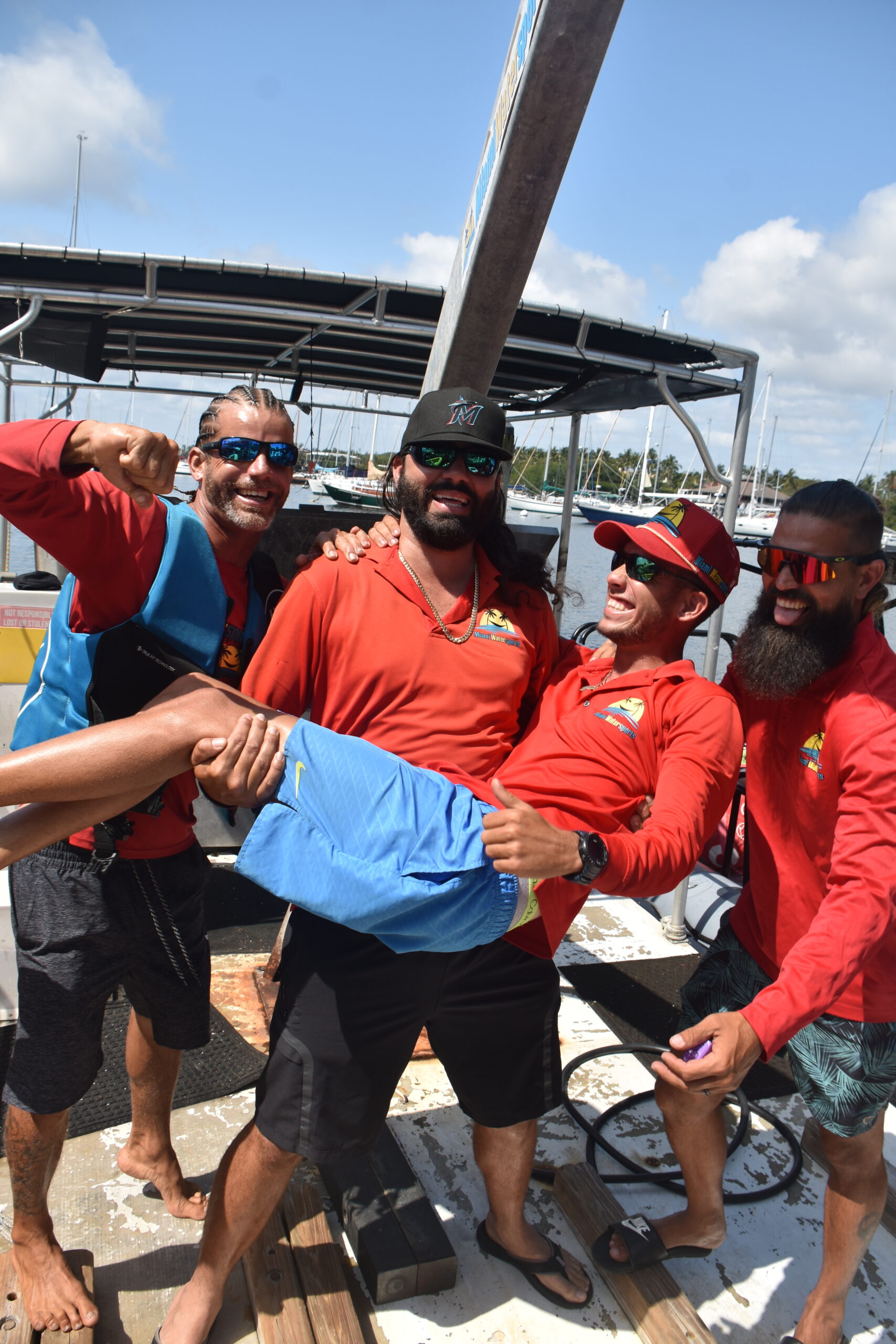
The Miami Watersports crew has run parasailing, jet ski, flyboard, and boat trips from Pier 9 at Dinner Key Marina in Coconut Grove since 2007.