Parasailing pictures: the short answer
Good parasailing pictures come from one of three places: a camera fastened to you in the air, a friend shooting from the boat deck, or the photo package we offer at check-in. Pick one before you get on the boat, because once you are in the harness there is no time to change the plan. Everything below is built on what our Miami parasailing trip page and our policies say, so you know what is allowed before you pack.
Here is the frame for the rest of the guide. You board at Pier 9 in Dinner Key Marina, ride out onto Biscayne Bay, and take turns in the air. The parasailing page lists each flight at 6 to 10 minutes inside a boat trip of up to an hour. A flight carries up to three people, solo, tandem or triple, and the boat carries up to 12. You take off from the boat's flight deck, climb up to 400 feet, and the crew reels you back onto the same deck.
That timing shapes every shot. Most of your hour is spent on deck, which is where the best pictures of other flyers come from. Your own minutes in the air are short, so the camera has to be ready, fastened and recording before you leave the deck.
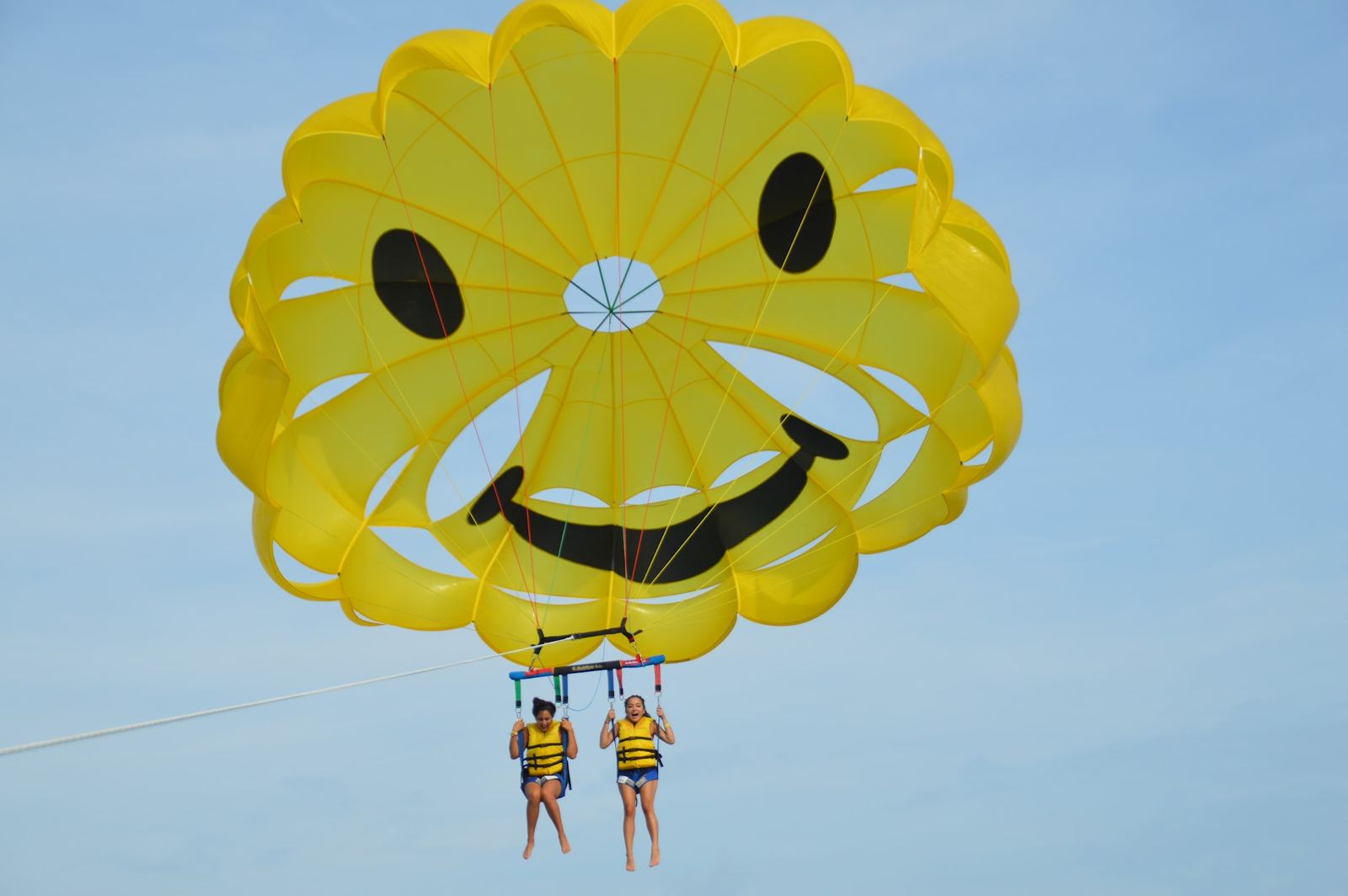
People also search for parasailing videos, and the same three options cover both. A video from your own camera shows the climb and the view the way you saw it. A video from the deck shows you, small and high under the canopy. The photo package covers both, with professional-quality photos and videos, according to our FAQs.
Three ways to get your photos, compared
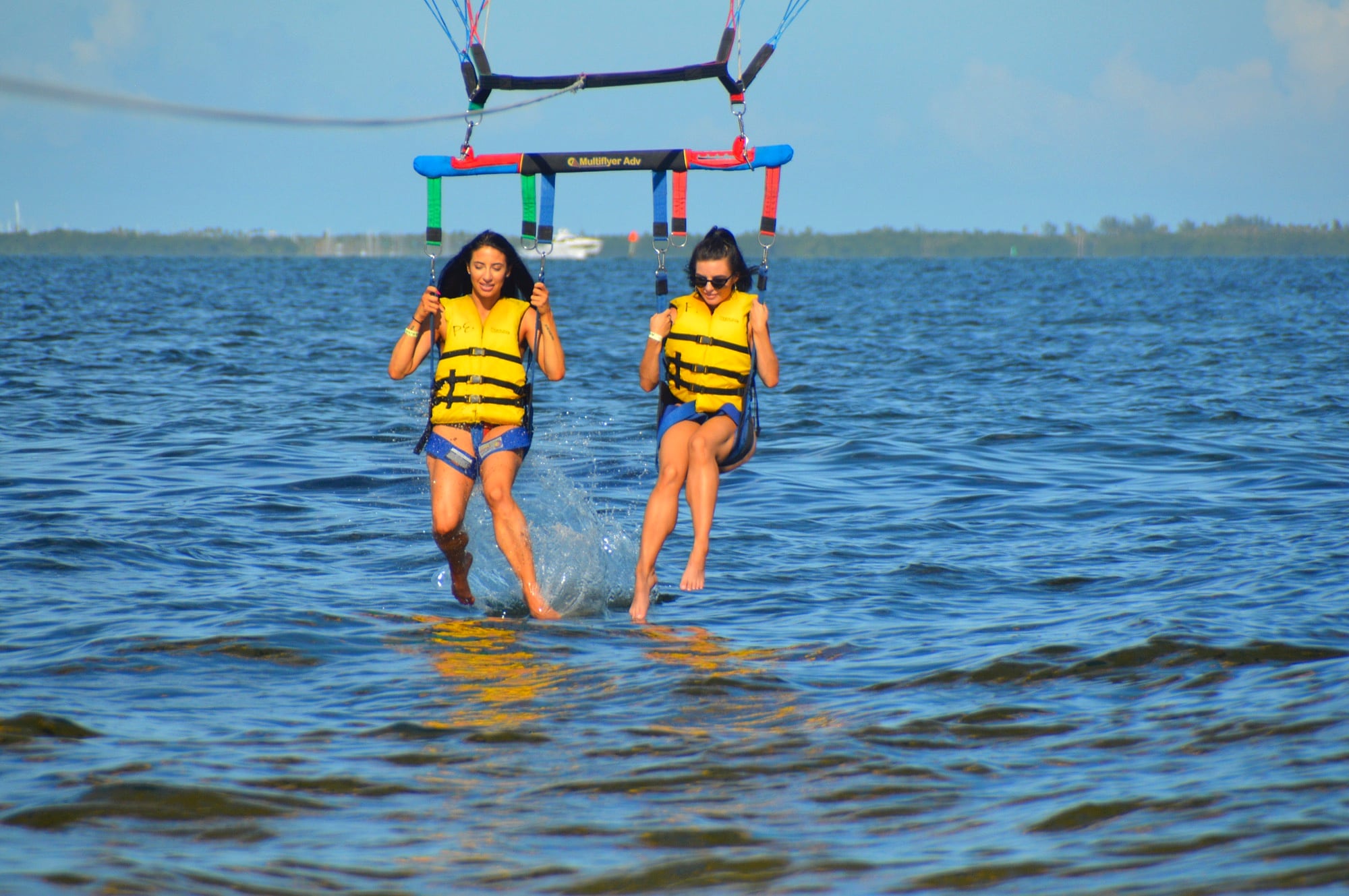
Each option gives you a different kind of picture. Most groups end up using two of them: one person films from the air while someone on deck or the photo package covers the shots of the flyers.
| Option | What you get | Where the rule comes from |
|---|---|---|
| Camera or GoPro fastened to you | Your view: the climb, the bay, the dip | Parasailing page |
| Phone in a waterproof case | The same view, on a lanyard | Policies |
| A friend on the boat deck | You under the canopy, takeoff and landing | Parasailing page, spectator rate |
| The photo package | Professional-quality photos and videos | Our FAQs |
A few points the table cannot hold. Your own camera only sees what is in front of you, so it rarely shows your face unless you turn it around, and turning things around 400 feet up is how they get dropped. A friend on deck sees the whole flight, but from a long way off once you are at height. The photo package takes the work off your hands, so you can spend the flight looking at the bay.
If you want the most complete set, pair the photo package with one secured camera for your own point of view. That gives you the outside shots and the view from the harness, and nobody has to juggle gear in the air.
What our pages say about cameras and phones
This is the one place where our own pages read differently, so here it is plainly, with where each line comes from.
“Pierre and Tommy made sure we had a blast despite our fears. The music set the vibe.”
Our parasailing trip details for Miami put "Camera or GoPro (secured to you)" on the what-to-bring list. The parasailing FAQ on the same page says you are welcome to bring a waterproof camera or GoPro, as long as it is securely attached to you so it cannot drop.
Our policies page, written for every activity at the marina, says only cell phones may be brought on activities and asks you to bring the minimum. It also says waterproof phone cases are sold at check-in, and that we are not responsible for lost or damaged phones, even inside one of our cases.
Because those two lines differ, go by the what-to-bring box on the parasailing page, and ask at check-in if you are unsure about a particular camera. That is the honest answer, and it is better than guessing on the dock.
| Question | What our pages say | Page |
|---|---|---|
| Can I bring a camera or GoPro? | Yes, if it is secured to you | Parasailing page |
| Can I bring my phone? | Phones may come on activities; bring the minimum | Policies |
| Are waterproof cases available? | Yes, sold at check-in | Policies |
| Who is responsible if a phone is lost? | You are, even with one of our cases | Policies |
| Is there a photo package? | Yes: professional-quality photos and videos | FAQs |
| Can a friend ride along to film? | The parasailing page lists a spectator rate, not booked online, paid at check-in | Parasailing page |
What every page agrees on is the part that matters most up high: anything you take into the air has to be fastened to you. A loose camera or a phone in a pocket is the wrong plan.
Getting a camera ready to fly
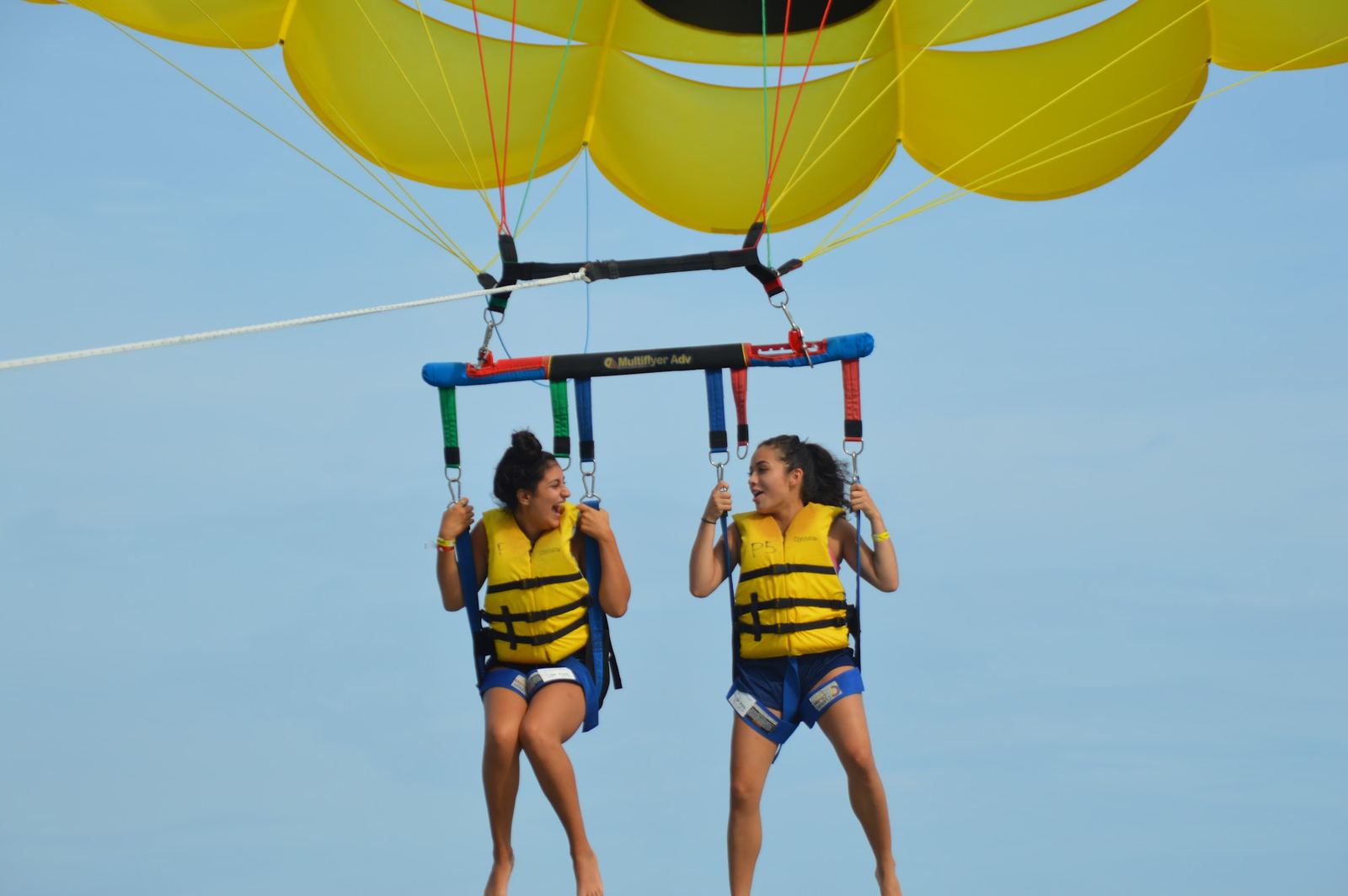
The work happens on the dock and on deck, before your turn. Once the crew calls your flight, they are busy getting you into the air, and you should be listening to them, not fiddling with a strap. Here is a simple order to follow.
- 1Charge and empty it at home. A dead battery or a full card ends the shoot before takeoff. Delete old clips the night before.
- 1Fit the mount or strap on land. A chest or wrist mount for an action camera, or a lanyard case for a phone. Put it on, pull on it, and make sure it holds with some force.
- 1Test the waterproofing. If you plan to take the dip, the camera or case has to keep water out. A case you have never closed before is a gamble.
- 1Pick one mode and leave it. Decide between photos and video on the dock. Switching modes mid-flight with wet fingers rarely works.
- 1Start recording before you sit down on the flight deck. Let it run through takeoff, the whole flight and the landing. Trim it later at home.
- 1Keep both hands for the harness when the crew asks. The camera hangs from you; it does not need holding during takeoff or the reel-in.
- 1Stop recording only when you are back on deck. The landing and the dip are often the best few seconds of the clip.
A chest mount tends to give the steadiest view, since it moves with your body and points where you face. A wrist strap gives you more freedom to point the camera at your partner, but every swing of the arm is a chance for the strap to slip. Whatever you use, the rule from our parasailing page holds: it has to be secured to you.
Three things are sorted at the check-in desk, so plan for them in the 15 minutes before departure. Ask about the photo package there. Pay the spectator rate there for anyone riding along without flying, since it is not booked online. And buy a waterproof phone case there if you need one, since our policies say cases are sold at check-in. If you are unsure about a particular camera, show it at the desk and follow what they tell you.
Sunglasses and hats belong in the same thinking. Anything that can slip off falls into the bay. Our post on what to wear for parasailing covers straps for sunglasses and hats, so the outfit and the camera plan work together.
Shots from the air, minute by minute
A flight is short, so it helps to know what is coming and where to point. The parasailing page describes each stage, and the table below adds what each one tends to give you on camera. The times are the page's own: 6 to 10 minutes in the air, up to 400 feet.
| Stage | What to film or shoot |
|---|---|
| On the flight deck | Your partner, the canopy filling, the crew's signal |
| Takeoff | The deck dropping away below you |
| The climb | The boat getting smaller, then the bay |
| At height, up to 400 feet | Slow looks around; your feet over the water |
| The descent | The boat growing larger as the crew reels you in |
| The dip, if you asked | Your feet touching the bay |
| Landing | Keep rolling until you are seated on deck |
Move slowly. Fast turns of the head or the camera make a clip hard to watch. If your camera is on your chest, turn your body gently to change the view, and hold each look for a few seconds. If it is on your wrist, keep the arm close and point rather than wave.
For a tandem or triple flight, agree before takeoff who is filming. One camera running the whole flight is better than three people each trying to get a shot. The others can wave at it, which also gives you the pictures with faces in them.
If you want to know what is in view once you are up there, our post on the 8 things you will see parasailing over Miami goes through it. Our guide to how high you go parasailing explains the climb to full height.
Shots from the boat deck
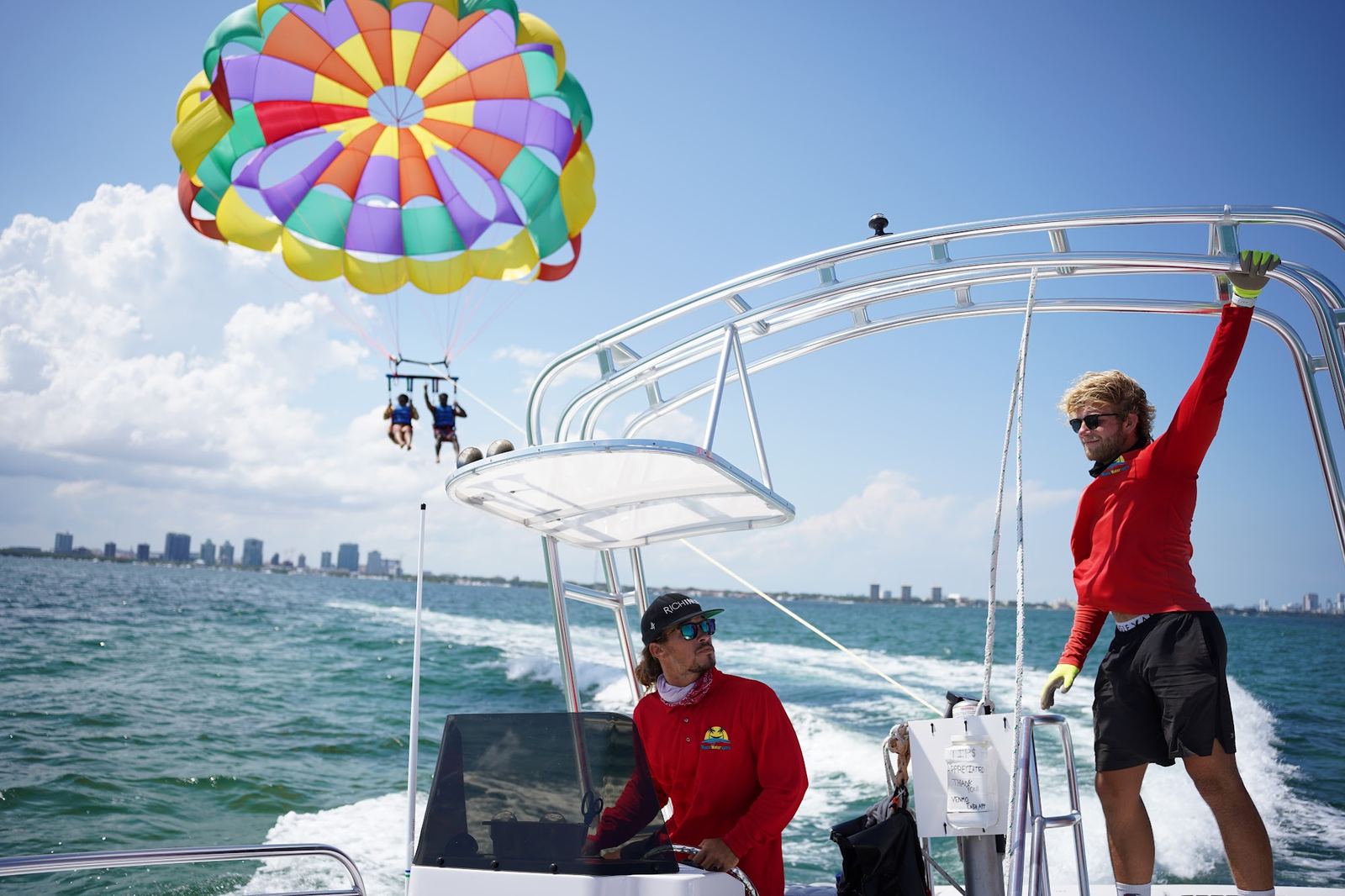
“Ray was amazing on the speed boat. Alex and Pierre were extremely helpful for parasailing.”
The deck is where the pictures of you come from. Flights take turns, and the boat carries up to 12 people, so you spend much of the hour sitting on deck while other flyers go up. That time is your photo shoot for the rest of your group.
If someone in your party does not want to fly, the parasailing page lists a spectator rate for riding along on the boat. It is not booked online; it is paid at check-in. A spectator with a phone in a waterproof case can cover every flight your group takes, from the outside, without anyone giving up their own flight time.
Some tips for whoever is shooting from the deck:
- Takeoff and landing are close up. They happen right on the flight deck, so these are the shots where faces are clear. Be ready before the crew starts the takeoff.
- At height, the flyers are small. A phone at its widest setting shows the canopy as a bright shape in the sky. Zoom in a little, or include the line running up from the boat to show how high they are.
- Stay seated and out of the crew's way. The crew works the flight deck the whole trip. Shoot from your seat and follow their instructions about where to be.
- Film the dip from the side. If a flyer asked for the dip, the moment their feet touch the bay is quick. Start recording as the descent begins.
- Keep the phone on its lanyard. Our policies say we are not responsible for lost or damaged phones, even in our cases, and anything dropped from the boat or the harness lands in the bay.
Swapping roles works well for couples and friends. Each person flies with a secured camera for the view from the harness, and the others film from deck. By the end of the trip, everyone has both kinds of picture.
Phones in the air: handling and settings
Many people take a phone instead of a camera, since our policies allow phones on activities and sell waterproof cases at check-in. A phone can take good parasailing pictures if it is handled with care.
The case comes first. A pouch-style waterproof case with a lanyard lets you hang the phone around your neck or wrist. Close it and test it on the dock, not on the boat. If you plan the dip, put the case under water in a sink at home first, if it is your own, so you know it holds.
Lock the camera settings before takeoff:
- Video beats photos for most flyers. You do not have to time a shutter press while the canopy pulls you up. Pull still frames from the video later.
- Turn off anything that needs a tap mid-flight. Wet screens and a pouch make touch controls unreliable.
- Use the main lens. The phone's standard lens usually gives the sharpest picture. Ultra-wide shows more of the bay but can bend the horizon.
- Leave flash off. It does nothing at that distance and only adds glare on the case.
- Turn on screen lock after you start recording, if your phone allows it, so a brush of the case does not stop the clip.
Hold the phone in front of your chest with the lanyard around your wrist, both elbows tucked. Look past the phone at the view, not at the screen. You will remember the flight better, and the clip will be steadier than if you chase the picture.
Bring the minimum, as our policies ask. One phone per flight is plenty. Everything else can stay in the group dock box or the car.
Pictures or videos: which to bring home
Parasailing videos and parasailing pictures answer different needs, and knowing which you want changes how you shoot.
A video is the easier choice in the air. It catches the takeoff, the climb and the dip without any timing, and you can pull a still image from it afterwards. It is also what most people want to share with friends, since it shows the motion of lifting off the deck. The downside is length: a full flight plus landing makes a long clip, so plan to trim it.
Photos work better from the deck. Someone sitting still on the boat can frame the canopy, the line and the flyers carefully, and take several shots as the flight goes on. Burst mode, if your phone has it, helps at takeoff and landing, when things move fastest.
The photo package covers both. Our FAQs describe it as professional-quality photos and videos of your parasailing adventure, which is the option for anyone who would rather fly with empty hands. Ask at check-in what the package includes and how you receive the files, since that is the moment to decide.
| You want | Best way to get it |
|---|---|
| Your view from the harness | Secured camera or phone, recording video |
| Pictures of you in the air | A friend on deck, or the photo package |
| Takeoff and landing close up | A friend on deck, or the photo package |
| The dip | Waterproof camera or case on your own body |
| Everything, with free hands | The photo package |
If you are doing a jet ski the same day, our post on the jet ski video from a Miami bay ride covers filming on the water, where the rules are different. The Miami jet ski rental page has the rules for that ride.
Worked examples: camera plans for real groups
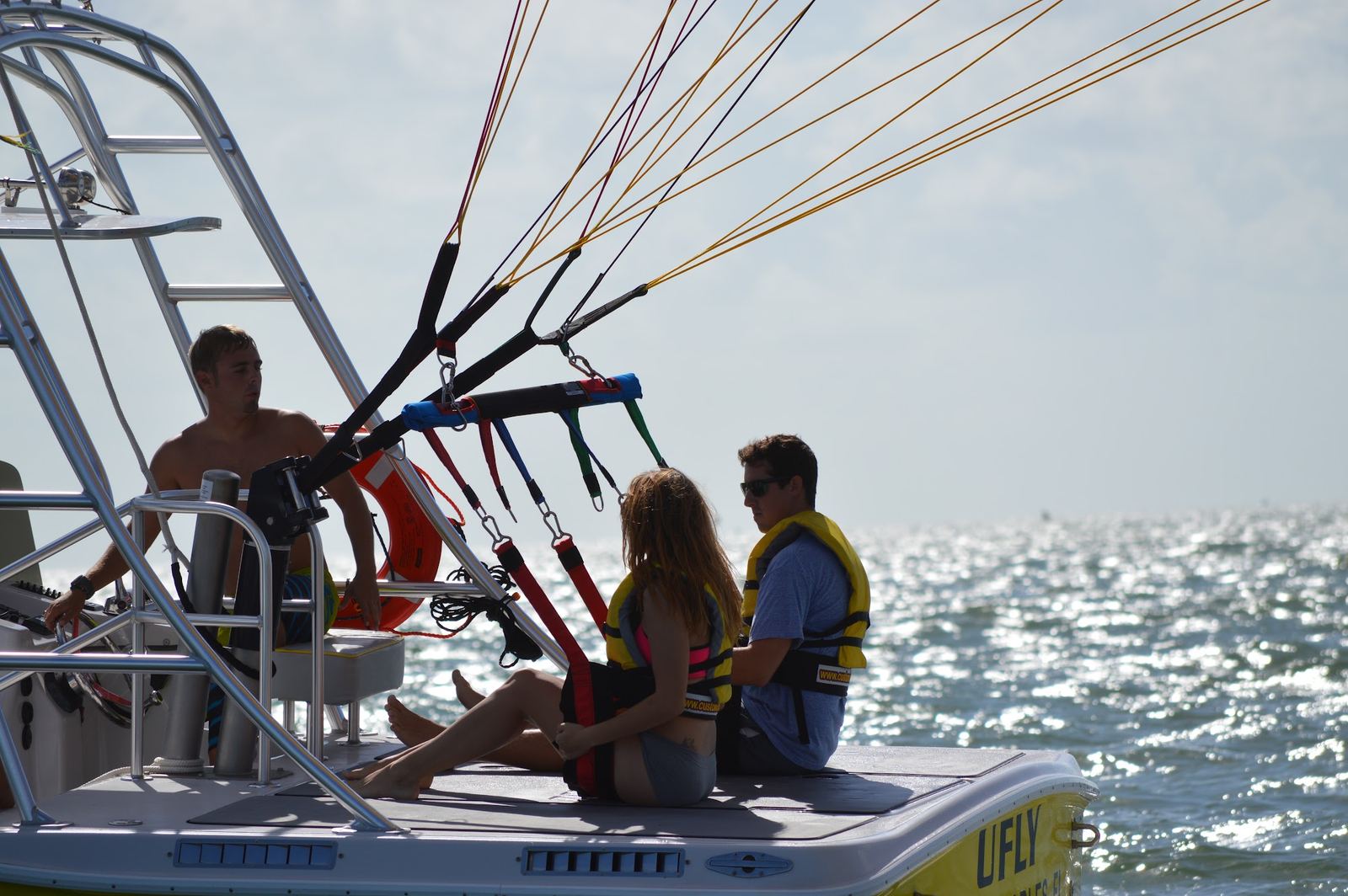
The same rules play out differently depending on who is flying. Here is how four common groups can split the job.
A couple flying tandem. The parasailing page allows up to 450 lb per flight, so most couples fly together. One of you wears a chest-mounted camera or a phone on a lanyard and records the whole flight. The other keeps both hands free and waves at it. Ask at check-in about the photo package if you want pictures of the two of you from the boat, since you are both in the air at once. For more ideas, see our post on parasailing for couples in Miami.
A parent and a young child. The minimum age is 5, and a parent or guardian signs the waiver. With a child beside you, your hands belong on the harness and on reassuring a small flyer, so skip your own camera. The photo package, or another adult on deck, is the better plan. Our guide to how old you have to be to parasail covers the rest of the rules for kids.
Three friends. Three is the most one flight takes, and the 450 lb limit applies to the whole flight. If you fly as a triple, put one camera on the middle flyer, who can see both friends. If you are split across flights, the ones on deck film the ones in the air, and you swap.
A family of five. A boat takes up to 12, but a flight takes up to three, so five people split into two flights. The two flights become two camera crews: whoever is on deck films whoever is up. One phone in a case, passed between flights on deck, is enough for the whole family.
In each case, decide the plan in the car, not on the boat. The trip moves quickly once flights start.
Light, weather and timing
Light changes your pictures more than any setting. We fly 7 days a week from 10am to sunset, year-round, weather permitting, so you can choose your time of day. Departures across our activities run every 30 to 60 minutes, according to our policies page.
The middle of the day gives bright, high light. Colours on the water are strong, but faces under a hat can fall into shadow. Later in the day the light gets lower and warmer, which tends to flatter people in photos. Our post on sunset parasailing in Miami covers late-day flights and how to time a booking around the light.
Weather is the crew's call. Certified staff watch the radar, and when conditions stop the trip you get a credit valid for 2 years toward any activity we run. A cloudy day can still give good pictures, as long as the crew is flying, so do not cancel your own plans over a few clouds.
Glare is the steady problem on the bay. A few habits help:
- Keep the lens clean and dry. Salt spray leaves spots, so carry a soft cloth on deck.
- Shoot with the sun behind or beside you when you can, from the deck.
- A case with a scratched window ruins pictures; use a new case or a clean one.
- Sunglasses help your eyes but not the camera, so do not shoot through them.
Leave some slack in your day. Our policies note that delays can happen for weather or equipment, and a relaxed group takes better pictures than one checking the time.
Your photo plan and booking
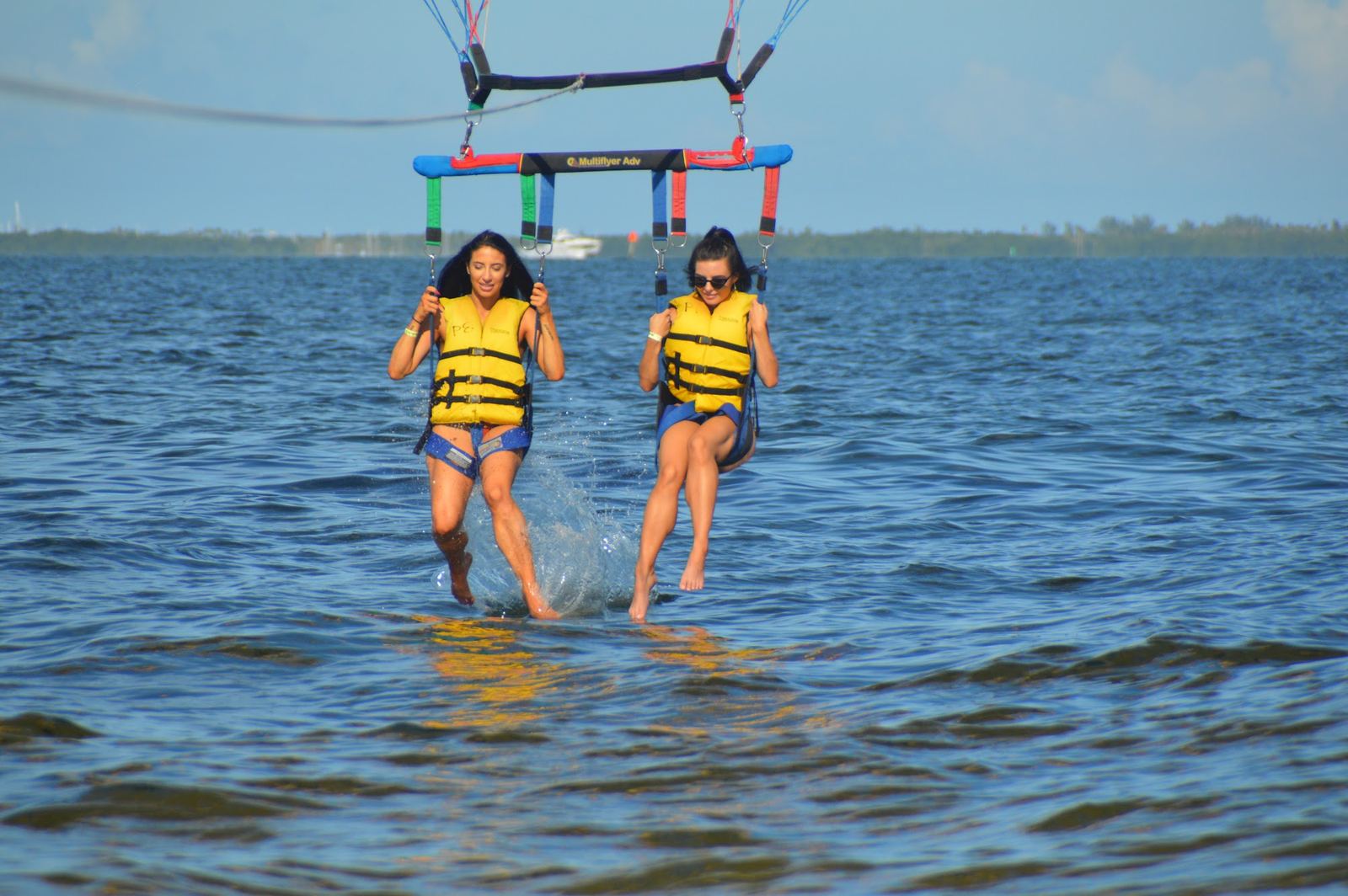
The short version, to screenshot before you leave home:
- 1Pick your method: a secured camera, a friend on deck, the photo package, or two of them.
- 1Fit and test the strap or case on land, and start recording before you sit on the flight deck.
- 1Swap roles with your group so everyone gets pictures of themselves.
When your camera plan is set, pick a date and book parasailing in Miami at Dinner Key Marina. Flights leave Pier 9 every day from 10am to sunset, weather permitting, and the Miami parasailing booking page shows what each flight includes and the times open today.
Book your Miami parasailing
Member rates apply on every booking. Tax & marina fee added at check-in.
Frequently asked questions