
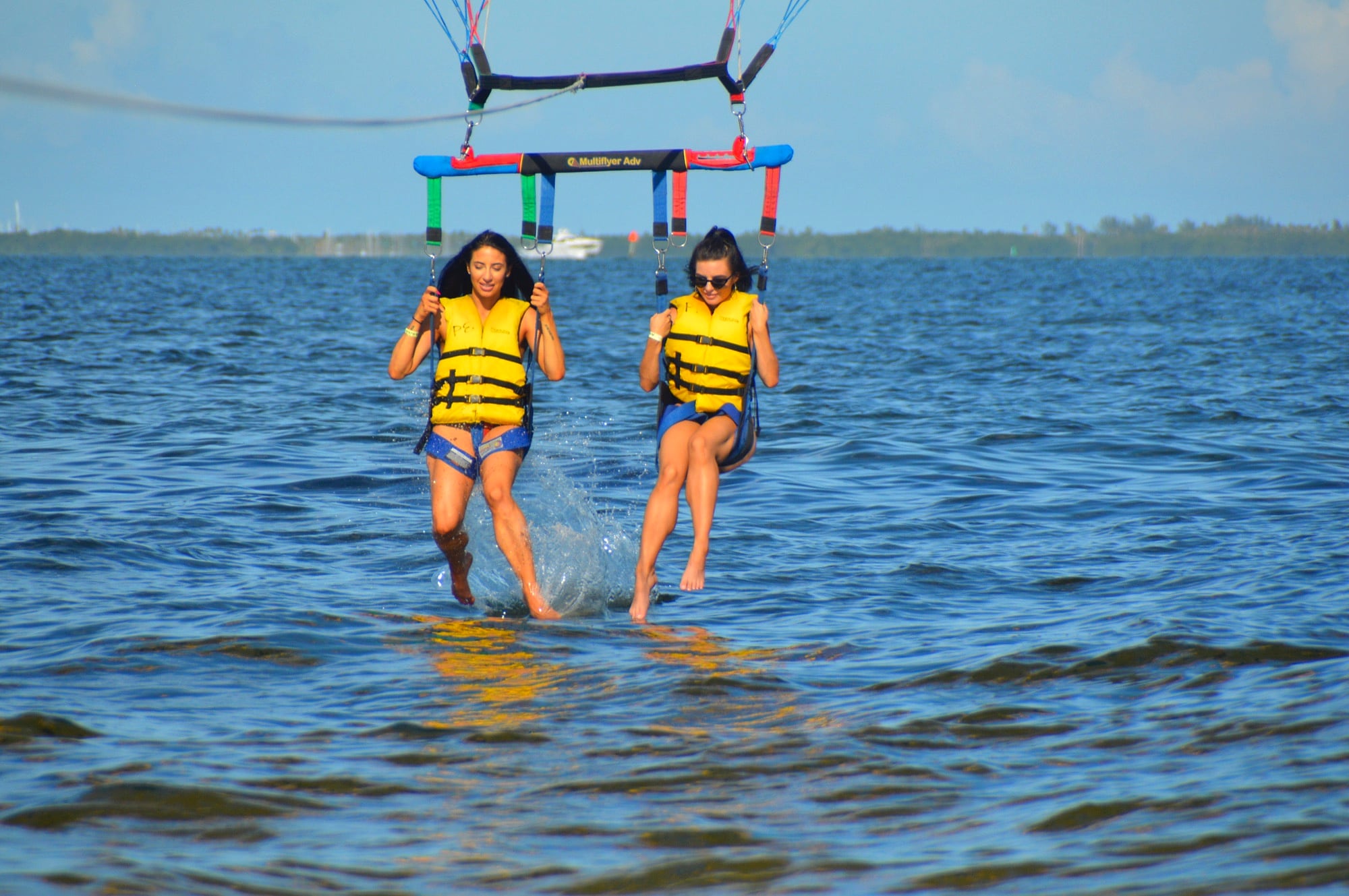
If you've ever wondered what you'll actually see while parasailing over Miami, the short answer is: a lot more than the skyline. From up to 400 feet over Biscayne Bay, the parasailing Miami views stretch from the Coconut Grove waterfront and downtown towers to historic Stiltsville, turquoise seagrass flats, passing dolphins, and the open Atlantic horizon. Launching dry off the boat's flight deck at Pier 9 in Dinner Key Marina, you rise above some of the calmest, most scenic protected water in South Florida — a very different vantage point than the crowded open-ocean rides off South Beach.
Key Takeaways
- Parasailing over Miami takes you up to 400 feet above Biscayne Bay, with roughly 6–10 minutes aloft on an approximately one-hour boat trip.
- The launch point is Pier 9 at Dinner Key Marina in Coconut Grove (3400 Pan American Drive), on calm, protected Biscayne Bay rather than the rougher open ocean off South Beach.
- Takeoff and landing happen dry, right off the boat's flight deck — you don't need to know how to swim to parasail here.
- Riders can go solo, tandem (two), or triple (three), up to a maximum combined weight of 450 pounds, with a minimum age of 5.
- Clear, shallow Biscayne Bay water makes it common to spot dolphins, manatees, rays, and seagrass flats from above; lightning always cancels a flight, but light rain usually doesn't.
- If weather or operations force a cancellation, you receive a marina credit that is valid for 2 years — there are no cash refunds.
Where You Launch: Pier 9, Dinner Key Marina, and the Calm Side of Biscayne Bay
Most people picture parasailing as a South Beach thing — boats bobbing in choppy Atlantic swell, a long wet wade out, and a quick yank into the air. Miami Watersports does it differently, and the geography is the whole reason why.
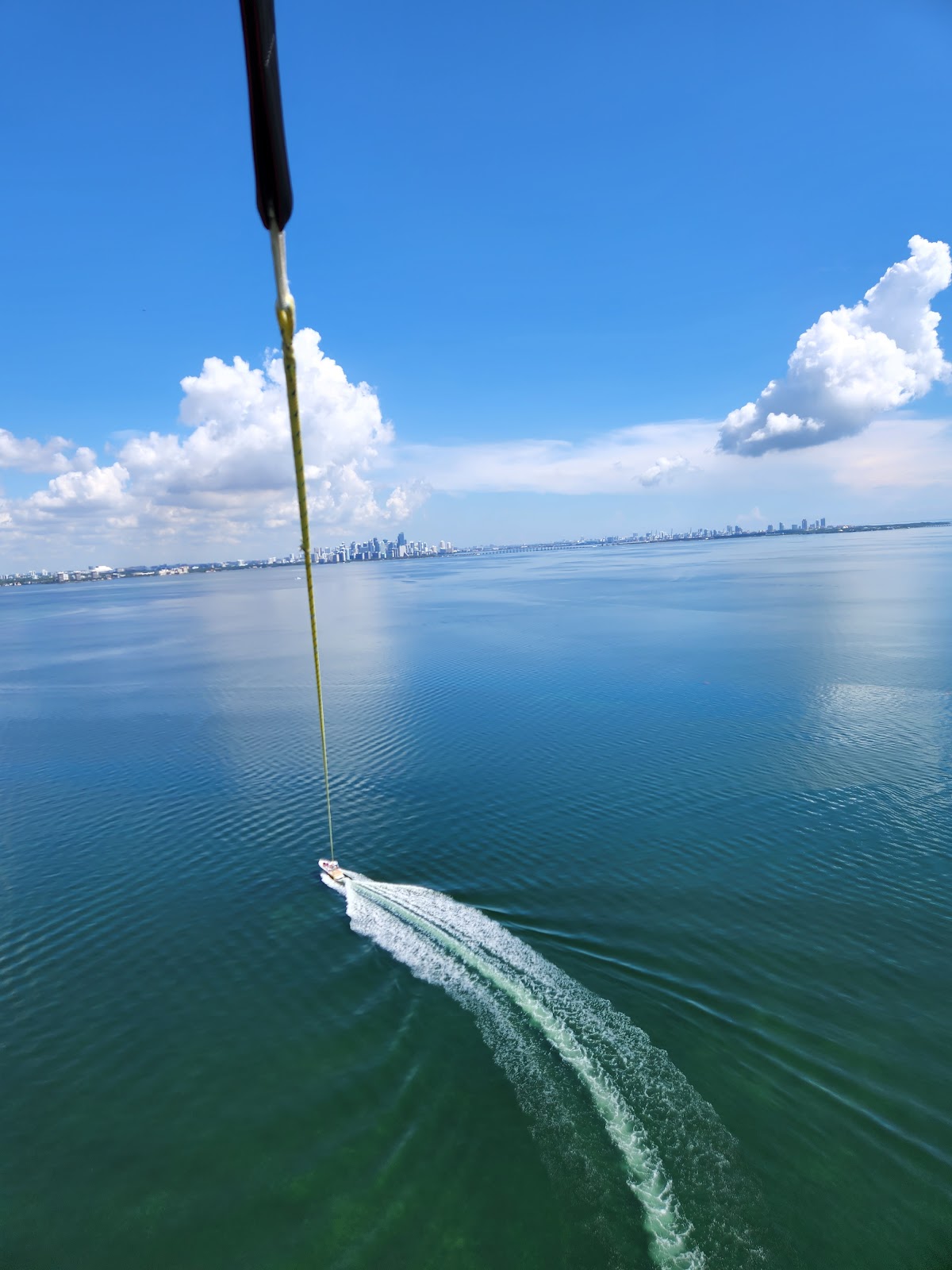
We launch from Pier 9 at Dinner Key Marina, 3400 Pan American Drive in Coconut Grove. This is the historic seaplane-era harbor on the western, sheltered shore of Biscayne Bay. Because the bay here is partly enclosed by barrier islands and the Florida mainland, the water tends to be flatter and calmer than the open ocean on the Miami Beach side. Calmer water means a smoother boat ride out, a steadier ascent, and a gentler, more controlled return to the flight deck.
That protected setting also changes what you see. Off South Beach, you're mostly looking at hotels and open water. From above the Coconut Grove side of the bay, you get layered scenery in every direction: the marina and tree-lined Grove shoreline below, the downtown Miami skyline to the north, the long ribbon of Key Biscayne and the Atlantic to the east, and the shallow, jewel-toned flats of the bay itself.
If you want the full picture of the experience before you go, the parasailing activity page has the current details and live pricing.
1. The Coconut Grove Waterfront and Dinner Key Marina From Above
The first thing you'll see as the boat pays out the line and you climb is the place you just left. Dinner Key Marina is one of the largest marinas in the region, and from a few hundred feet up the rows of sailboat masts, the historic green-roofed seaplane terminal buildings, and the curve of the Coconut Grove shoreline read like a model village.
Coconut Grove is Miami's oldest continuously inhabited neighborhood, and from above its character shows — dense tree canopy, waterfront parks, and a shoreline that's far greener than the concrete edges further north. On a clear morning, the contrast between the deep blue of the marina basin and the lush canopy of the Grove is one of the most photogenic parts of the whole flight.
2. The Downtown Miami and Brickell Skyline
Look north and the skyline does the heavy lifting. The towers of Brickell and Downtown Miami stack up along the bayfront, and from 400 feet over the water you get a clean, unobstructed sightline across the bay to the city — no buildings in the way, just water and then skyscrapers.
This is one of those vantage points you simply cannot get from the ground or even from most rooftops. Because you're suspended over open water with the whole bay between you and the city, the skyline appears to float on the horizon. Mid-morning light and late-afternoon golden hour are both excellent; the glass towers catch the sun and the bay turns from teal to gold.
3. Stiltsville: Miami's Houses on the Water
One of the most surprising things you'll spot — and a genuine piece of local history — is Stiltsville. These are a small cluster of wood-frame houses standing on pilings out in the shallow flats of Biscayne Bay, near the edge of Biscayne National Park. They date back to the 1930s, when fishing shacks and social clubs first went up over the water far from shore.
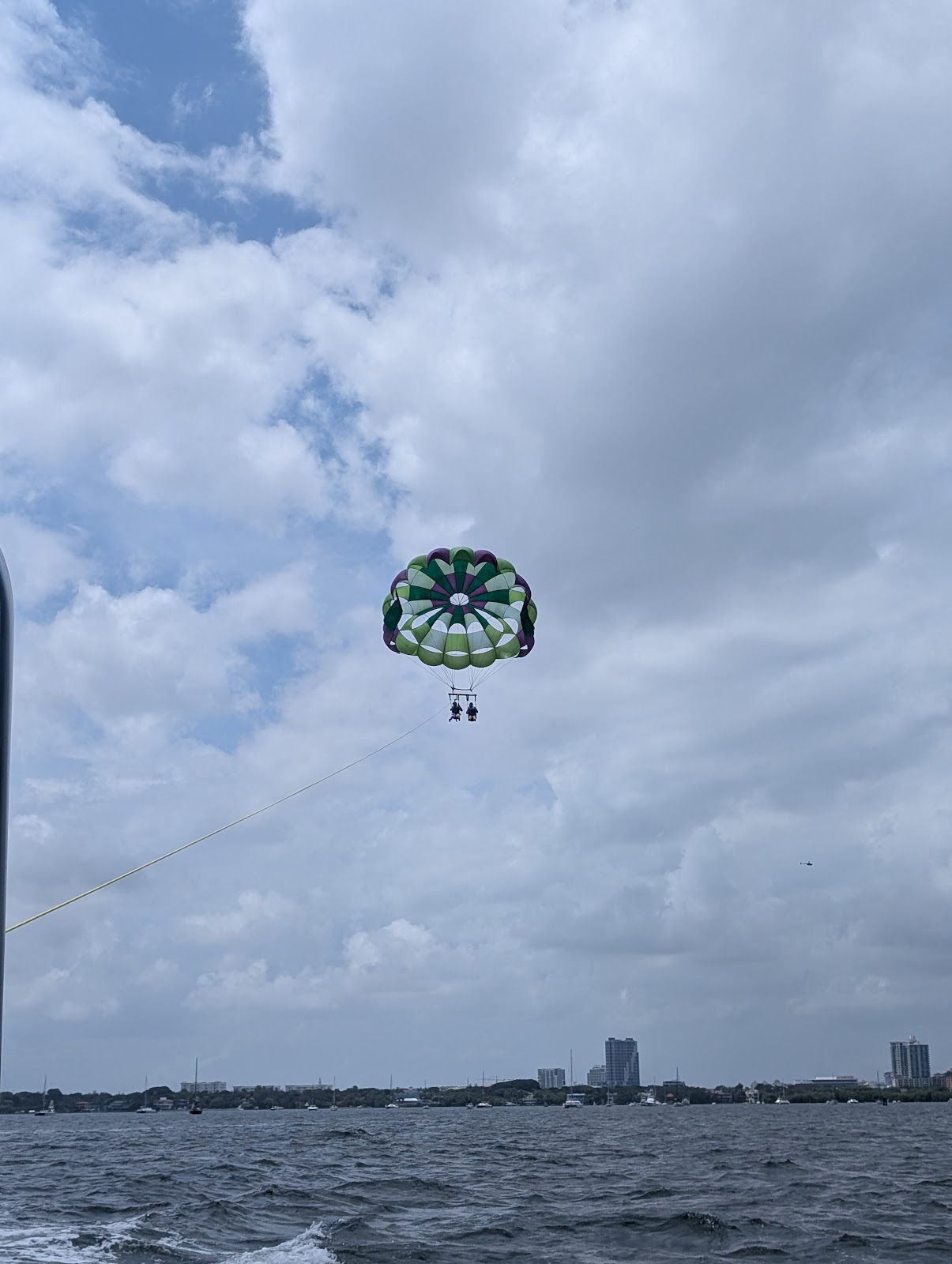
From sea level, Stiltsville is hard to make sense of — it just looks like specks on the horizon. From up high while parasailing, you can actually see the houses sitting in open water with no land around them, ringed by pale sandbars and seagrass. The structures are now managed within the protected waters of Biscayne National Park, which preserves much of southern Biscayne Bay and helps keep the water and habitat around them so clear.
4. Dolphins, Manatees, Rays, and Marine Life in the Shallows
Here's where parasailing over Biscayne Bay genuinely beats most other vantage points: the water is shallow and clear, and you're looking straight down into it. That combination makes wildlife spotting better from the air than from the boat deck.
What you might see
- Bottlenose dolphins are the crowd favorite. They frequent the bay and often travel in small pods; from above you can sometimes track them moving just under the surface before they break it.
- Manatees are slow, gentle, and surprisingly large — their rounded shapes are easy to pick out against light seagrass flats, especially in the cooler months when they move into warmer, sheltered water.
- Rays glide across sandy patches as dark diamond shapes, often visible against the pale bottom.
- Sea turtles and schools of fish round out a typical day's wildlife.
Nothing about wildlife is guaranteed on any given flight — these are wild animals in open water. But the protected, shallow nature of the bay genuinely improves your odds, and the height gives you a "bird's-eye aquarium" view you don't get at the surface. Florida's wildlife and waterways are managed by the Florida Fish and Wildlife Conservation Commission, and watching marine life from a respectful distance overhead is about as low-impact as wildlife viewing gets.
5. The Seagrass Flats and the Color of the Water
People are often most stunned not by a single landmark but by the water itself. Biscayne Bay's bottom is a patchwork of seagrass meadows, sandbars, and channels, and from altitude that patchwork turns into a living map of greens, teals, and pale sand-yellows.
The darker patches are seagrass — the same habitat that feeds manatees and shelters fish. The bright, glowing turquoise areas are shallow sand flats where sunlight bounces straight off the bottom. The deeper navigation channels cut through as ribbons of richer blue. On a calm, sunny day with good light, the color gradient across the flats is the photo everyone wants, and it's only really legible from the air.
This clarity isn't a given everywhere in Miami — it's a function of the bay's shallow depth and the protections around its southern reaches. It's also why a flight launched from the Coconut Grove side, over the flats, shows you something distinctly different from an open-ocean ride.
6. Key Biscayne, the Lighthouse, and the Atlantic Horizon
Turn your gaze east and the scene opens all the way to the Atlantic. Key Biscayne and Virginia Key form the barrier between the calm bay and the open ocean, fringed with beaches and the green of Crandon Park and Bill Baggs Cape Florida State Park.
At the southern tip of Key Biscayne stands the Cape Florida Lighthouse — the oldest standing structure in Miami-Dade County. On clear days you can pick it out against the trees. Beyond the keys, the color of the water shifts from the bay's teal to the deeper blue of the Atlantic, and the horizon line stretches uninterrupted. Watching the calm bay on one side and the open ocean on the other, with the barrier islands threading between them, is a geography lesson you absorb in a single glance.
7. Sailboats, the Marina Channel, and Miami's Boating Life
Biscayne Bay is one of the great sailing and boating grounds in the country, and from above you'll see why. Sailboats lean into the breeze, powerboats cut white wakes across the flats, and the marked channels guide everyone through the shallows. From your perch you can follow the geometry of it all — the way boats fan out from the marina mouth, the wakes crisscrossing, the sandbar gatherings on weekends.
There's a safety story here too. The bay is busy, and Miami Watersports operates under U.S. Coast Guard and Florida boating rules with experienced captains who manage the line, the traffic, and the wind. If you're curious about how boating safety works on these waters, the U.S. Coast Guard's boating safety resources and Florida's boating and waterways information are the authoritative places to read up. From your seat in the harness, all you have to do is enjoy the view while the crew handles the rest.
8. The Sky, the Clouds, and the Light Itself
The last thing you'll see is harder to name. At 400 feet over open water, the sky becomes part of the scenery. South Florida's towering summer cumulus clouds, the way light scatters across the bay at golden hour, the occasional rainbow after a passing shower — being up in it, rather than under it, changes how you experience Miami weather.
That's also why weather drives the whole operation. Parasailing depends on wind and visibility, and the team watches conditions closely against forecasts from sources like the National Weather Service in Miami. Lightning is an absolute no-go — flights never run when there's lightning around. Light rain, on the other hand, usually doesn't stop a trip, and a moody, post-shower sky can be spectacular from above. If conditions do force a cancellation, you don't lose out: weather and operational cancellations are covered by a marina credit that is valid for 2 years.
When to Go: Seasons, Light, and Conditions on Biscayne Bay
The view changes with the calendar, so timing matters.
Winter and early spring bring Miami's clearest, driest air. Cooler, crisper days often mean the sharpest skyline visibility and the best long-range views toward the keys and the Atlantic. This is also prime manatee season, when the gentle giants move into sheltered bay water.
Late spring through early fall is warmer and greener, with that signature glowing turquoise over the flats when the sun is high. Summer afternoons can build dramatic clouds and pop-up showers, which is why morning flights tend to be the most reliable in the wet season — the bay is usually calmest and the sky clearest before midday heat builds storms.
Golden hour, in any season, is the photographer's pick. The low sun lights the skyline, warms the water's color, and softens the whole bay. Whatever the season, calm wind and good visibility are what the crew is looking for, and the protected Coconut Grove launch helps deliver smoother conditions more often than the exposed ocean side.
What the Flight Itself Is Like
Knowing the mechanics helps you relax and look around instead of gripping the harness.
You board the boat at Pier 9 and ride out into the bay. When it's your turn, you're harnessed in on the boat's flight deck and the captain gently lets out the towline — you lift off dry, straight from the deck, no wading and no swimming required. You can fly solo, tandem, or triple, up to a combined maximum of 450 pounds, and riders need to be at least 5 years old. Swimming ability isn't required, which makes this one of the most accessible big-thrill activities in Miami for families and nervous first-timers alike.
Once aloft, you'll spend roughly 6 to 10 minutes in the air on a trip that runs about an hour door to door, including the boat ride and getting everyone up and down. The ascent is smooth and surprisingly quiet — most of the noise of the boat falls away, and you're left with wind, water, and the view. At the end, the captain reels you back in for a soft, dry landing on the flight deck.
For families combining activities, parasailing pairs naturally with other on-water options; you can browse the full lineup, including jet ski rentals and the boat tour, to build a half-day on the bay.
Member Rate vs. Non-Member Rate: How Pricing Works
Pricing at Miami Watersports works a bit like a hotel, with two ways to pay.
- Member rate: Members get our current member pricing on the ride, and then add a fuel charge plus a tax and marina fee that's collected at check-in at the dock. The live member rate is always shown on the parasailing activity page.
- Non-Member rate: Non-members pay a single all-in rate with nothing extra added at the marina — what you book is what you pay.
Because pricing is per rider and is served live from our system, we never publish fixed numbers in articles like this — they'd go stale. Always check the parasailing activity page for the current, accurate member and Non-Member rates before you book. And remember: if weather or operations cancel your flight, you receive a marina credit that is valid for 2 years rather than a cash refund, so you're never out anything when the bay doesn't cooperate.
A Few Tips to Get the Most Out of the View
- Bring sunglasses with a strap. The glare off Biscayne Bay is real, and you'll want to keep your eyes comfortable so you can actually take in the color of the flats.
- Secure your phone or camera. A wrist strap or zipped pocket is essential at altitude. The skyline-over-water shot is worth it, but not worth dropping your phone into the bay.
- Aim for morning in summer. Calmer water and clearer skies before the afternoon storms build means a smoother flight and better visibility.
- Listen to the captain on weight and seating. Solo, tandem, and triple flights are balanced by the crew within the 450-pound combined limit; they'll set you up for the best ride.
- Don't stress about swimming. Takeoff and landing are dry off the flight deck, so non-swimmers can fully enjoy the experience.
For a deeper read on general on-water safety and education before any boating activity, the BoatUS Foundation's expert advice library is a solid, independent resource.
Conclusion: See Miami From a Whole New Angle
The parasailing Miami views from Pier 9 are unlike anything you'll get at street level or from a hotel balcony: the Coconut Grove canopy and Dinner Key Marina below you, the Brickell skyline floating across the bay, historic Stiltsville out on the flats, dolphins and rays gliding through clear shallows, Key Biscayne and the lighthouse to the east, and the open Atlantic beyond. Launching dry from the calm, protected side of Biscayne Bay — not the crowded open ocean off South Beach — gives you a steadier ride and richer, more layered scenery in every direction.
Whether you're flying solo for the thrill or going tandem or triple to share the moment, this is the rare Miami experience that's genuinely accessible — no swimming required, kids from age 5, and a smooth dry takeoff and landing. Check the live member and Non-Member rates and reserve your spot on the parasailing activity page, and we'll see you up above Biscayne Bay. Questions before you book? Call us at (786) 713-8006.
Book your Miami parasailing adventure
Member rates apply on every booking. Tax & marina fee added at check-in.
Frequently Asked Questions
About Miami Watersports
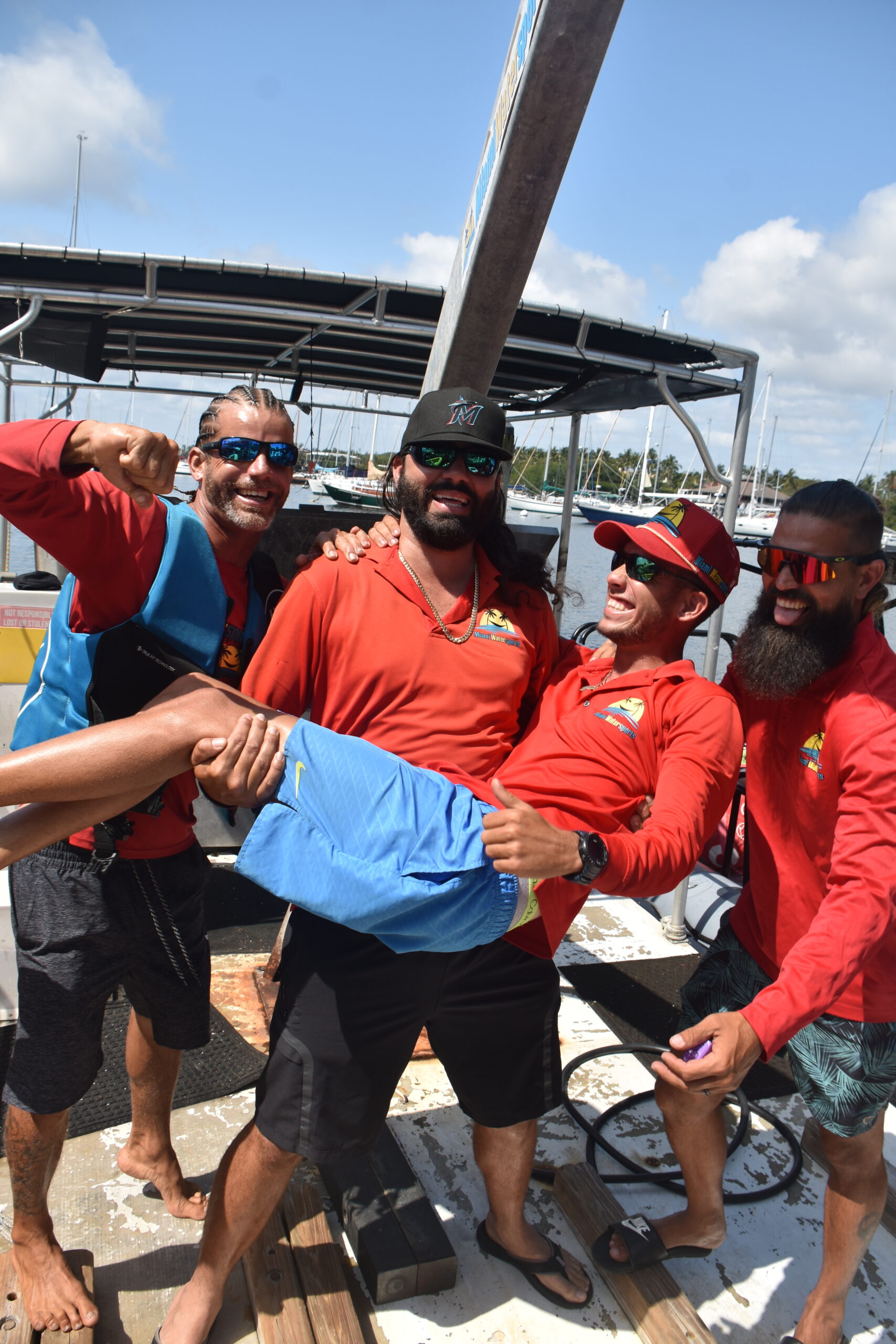
The Miami Watersports crew has run parasailing, jet ski, flyboard, and boat trips from Pier 9 at Dinner Key Marina in Coconut Grove since 2007.