
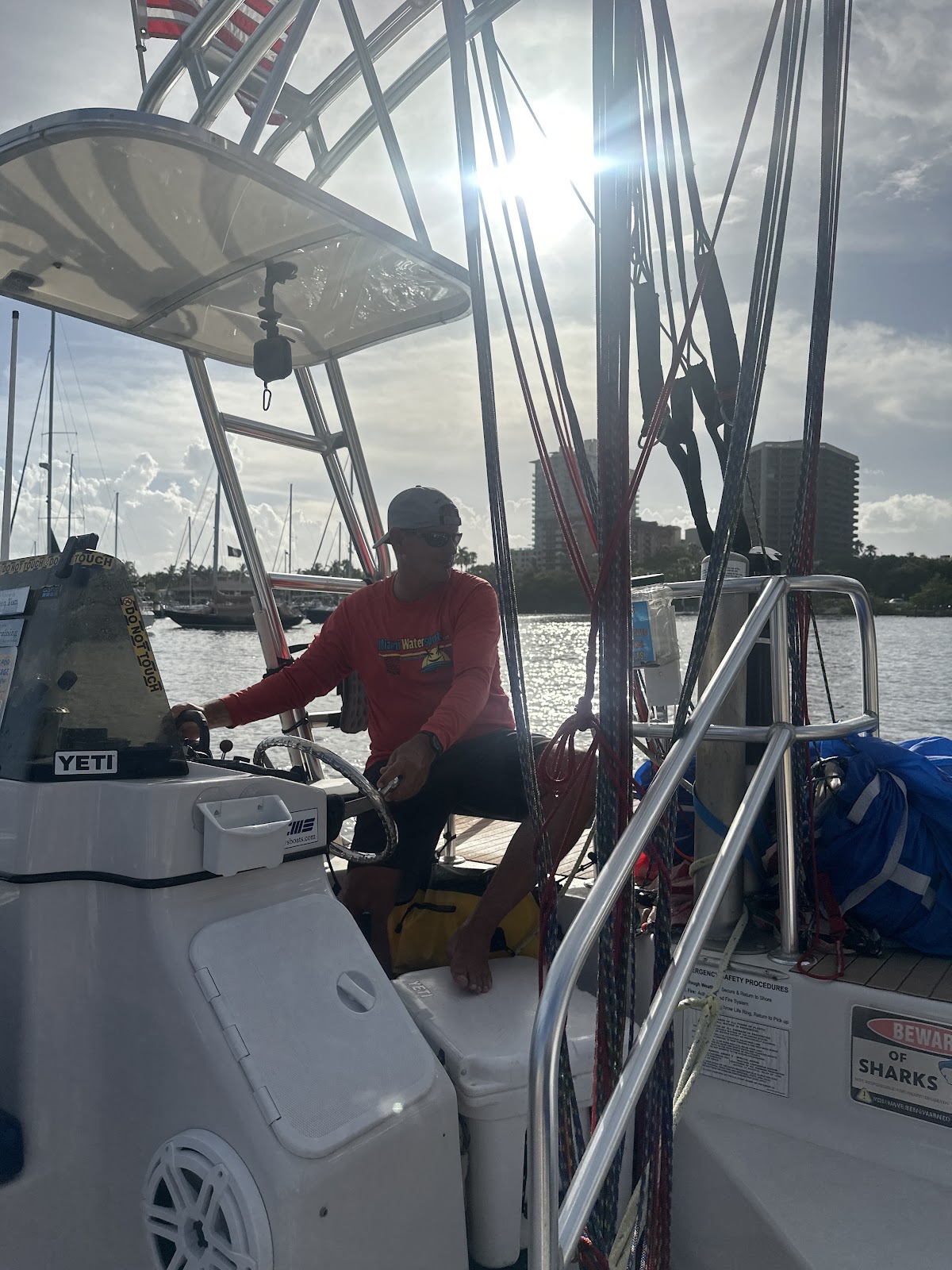
Parasailing works by using a boat to pull a person attached to a specially shaped canopy, called a parasail, through the air. As the boat accelerates and the wind flows over the curved canopy, it generates lift, the same aerodynamic force that holds an airplane in the sky, gently raising you off the boat and up to several hundred feet above the water. If you have ever wondered how does parasailing work, the short answer is that it combines forward boat speed, a parachute-like wing, and a controlled tow line into one of the calmest, most scenic ways to leave the ground anywhere in Miami.
At Miami Watersports, we launch from Pier 9 at Dinner Key Marina in Coconut Grove, sending guests up to 400 feet over the protected, glassy waters of Biscayne Bay. Below is the real science behind that thrill, explained by people who run these flights seven days a week, plus exactly what to expect on the day you fly.
Key Takeaways
- Parasailing generates lift the same way an aircraft wing does: airflow over a curved canopy creates lower pressure above and higher pressure below, pushing the rider upward as the boat tows them forward.
- At Miami Watersports, riders ascend up to 400 feet above Biscayne Bay on a roughly one-hour trip, with about 6 to 10 minutes actually airborne at peak altitude.
- Modern parasailing uses a dry takeoff and landing directly from the boat's flight deck, so most riders never touch the water and swimming is not required.
- Flights run solo, tandem, or triple, with a maximum combined weight of 450 pounds and a minimum age of 5 for riders.
- Biscayne Bay's calm, sheltered water and steady sea-breeze conditions make Coconut Grove a smoother, more stable place to parasail than the crowded open-ocean side near South Beach.
- Lightning always grounds flights, while light rain usually does not; weather or operational cancellations earn a marina credit that is valid for 2 years rather than a cash refund.
How Does Parasailing Work? The Physics of Flight
To understand parasailing, picture three forces working together: thrust from the boat, lift from the canopy, and the tension of the tow line connecting them.
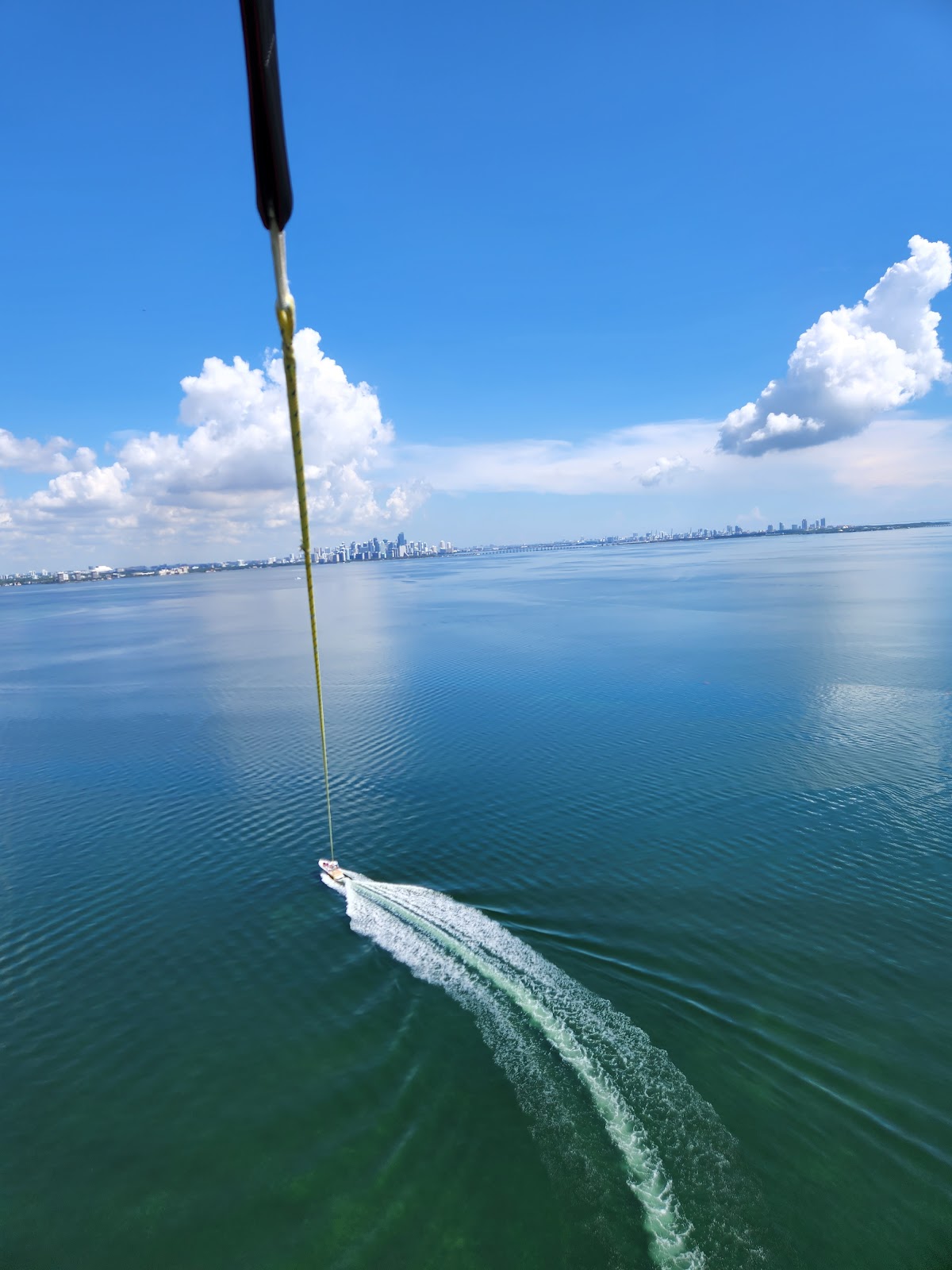
The boat provides thrust. As it powers forward, it drags the parasail and rider through the surrounding air. That relative motion, air moving across the canopy, is the engine of the whole experience. Unlike an airplane, which carries its own engine aloft, a parasailer borrows the boat's horsepower through a long tow rope.
The canopy provides lift. A parasail is not a flat sheet; it is an airfoil, a wing with a curved upper surface and a flatter lower surface. When air flows over that shape, it travels faster across the curved top and slower along the bottom. Faster-moving air exerts less pressure, so the pressure underneath the canopy becomes greater than the pressure above it. That pressure difference is lift, and when there is enough of it, you rise. This is the same principle the BoatUS Foundation and aviation educators describe for any wing: shape plus airflow equals upward force.
The tow line ties it all together. The rope transfers the boat's pull to the rider while the angle of the canopy, called the angle of attack, controls how aggressively it climbs. The crew adjusts your altitude simply by letting out or reeling in the line with a hydraulic winch. Let out more rope and you climb; reel it in and you descend, smoothly and predictably.
Why You Float Instead of Fall
A common worry is that parasailing feels like skydiving. It does not. Because the canopy is always generating lift and the boat maintains steady speed, the system reaches a stable equilibrium. The lift force balances your weight, the tow tension holds you at a set distance, and you simply hang there, suspended, while the bay slides by underneath. There is no sensation of falling because nothing is falling. You are being held up by the air itself, the way a kite holds steady on a windy afternoon.
The Dry Takeoff: Launching From the Flight Deck
Decades ago, parasailing meant running off a beach or being hauled out of the water. That is no longer how it works at a professional operation. Today the entire launch happens from the boat.
Our vessels have a raised platform at the stern called a flight deck. The crew clips you into a padded harness, attaches the harness to the parasail, and as the boat builds speed the canopy fills with air behind the boat. The winch then pays out the tow line and you lift gently off the deck. No running, no jumping, no plunging into the water. This is what people mean by a dry takeoff and landing: you leave from the boat and you return to the boat.
That single design change is why parasailing is now accessible to so many people. Because you never have to swim to or from the canopy, swimming is not required to fly with us. Riders who are nervous about deep water can still enjoy the full experience, and families bring children as young as 5.
Solo, Tandem, and Triple Flights
Lift scales with canopy size and boat speed, which is why we can safely fly more than one person at once. We offer:
- Solo flights for the rider who wants the sky entirely to themselves.
- Tandem flights, the most popular choice, where two people share the harness bar side by side.
- Triple flights for three, ideal for families and friend groups who want to go up together.
The hard limit is a maximum combined weight of 450 pounds across the riders on a given flight. That number is not arbitrary; it reflects the lift the canopy and boat can reliably produce while keeping a comfortable safety margin. Our crew weighs and pairs riders accordingly before every launch.
Biscayne Bay: Why Location Is Part of the Science
The same physics applies everywhere, but the quality of the flight depends enormously on where you do it. This is where Miami's geography gives Coconut Grove a real advantage.
Dinner Key Marina sits on Biscayne Bay, a wide, shallow body of water shielded from the open Atlantic by a chain of barrier islands and the curve of the coastline. That shelter matters. Open-ocean swell, the kind you find on the South Beach side, creates choppier water and gustier, less predictable wind near the surface. Choppy conditions translate into a bumpier boat ride and more variable lift. Calm water, by contrast, lets the boat hold a smooth, constant speed, which produces a smooth, constant climb.
Biscayne Bay is also a protected and ecologically rich environment, bordering Biscayne National Park, one of the largest marine parks in the national park system. From 400 feet up over the Grove, the science gives way to scenery: seagrass flats glowing turquoise, the downtown Miami skyline, the green canopy of Coconut Grove, and on clear days the distant line of the Florida Keys. It is a fundamentally different, calmer view than the dense traffic of the open-ocean tourist corridor.
The Sea Breeze and the Best Time to Fly
Miami's daily weather is driven by the sea breeze, the air movement created as land heats faster than water. Mornings on the bay are typically calmest, with lighter, steadier wind that makes for the gentlest, most stable ascents. As the day warms, the breeze strengthens and afternoon thunderstorms can build inland, especially in the summer wet season. That is one reason many guests choose a morning slot for the smoothest flight and the best light for photos.
You do not need to be a meteorologist to plan around this. Our crew monitors conditions continuously, and you can always check the regional forecast through the National Weather Service in Miami before you head out.
How High Is 400 Feet, Really?
Up to 400 feet is the ceiling we fly to over Biscayne Bay, and it is higher than it sounds. For perspective, that is roughly the height of a 35 to 40 story building. From that altitude the horizon opens up dramatically, yet you are still close enough to pick out boats, sandbars, and the occasional ray or manatee gliding through the clear shallows.
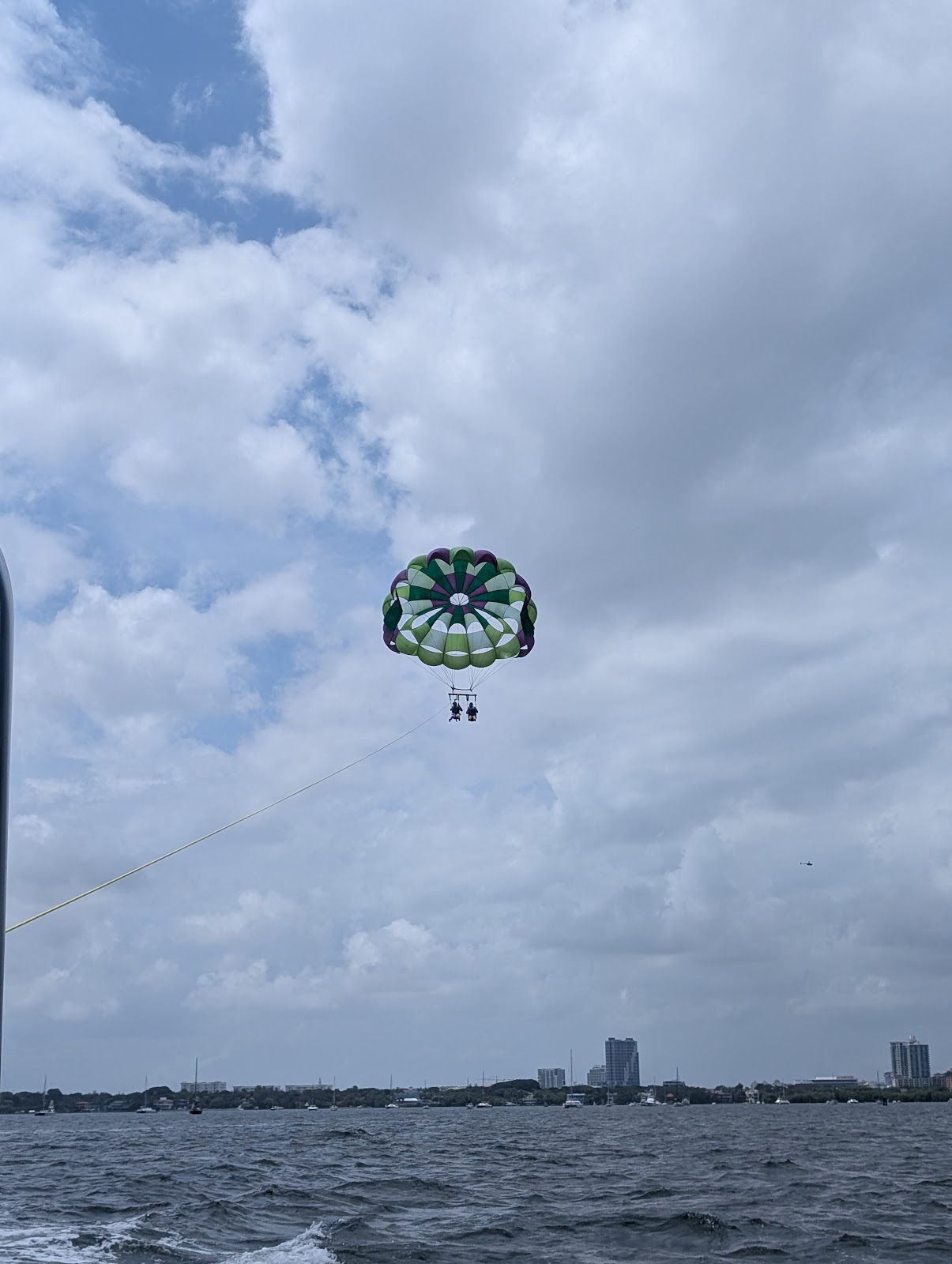
Altitude is entirely under the crew's control through the winch and tow line, so the experience is tailored rather than extreme. Riders who want the full, top-of-the-sky view get it; those who prefer to stay a little lower can ask the crew to keep the line shorter. Either way, you spend roughly 6 to 10 minutes aloft at altitude, framed inside a total trip of about an hour that includes boarding, the ride out to the flight zone, each group's launch and recovery, and the cruise back to the dock.
That hour is part of the appeal. Parasailing is not a frantic, white-knuckle ride. It is a slow, panoramic, almost meditative few minutes hanging in quiet air, with the boat's engine a distant hum below and the whole of southern Biscayne Bay laid out around you.
Safety, Weather, and Florida Boating Regulations
Parasailing is run as a boating activity, which means it sits under the same safety and waterway rules that govern every commercial vessel on the bay. Florida takes this seriously, and so do we.
The boats we fly from carry Coast Guard required safety equipment and operate under federal and state navigation rules. You can read the foundational boating safety guidance from the U.S. Coast Guard and Florida specific waterway rules from the Florida Fish and Wildlife Conservation Commission, which oversees boating and waterways across the state. Florida's vessel and boater education framework is published by the FLHSMV Boating Safety Center. These are the same authorities that set the standards our captains operate under every day.
The Weather Policy in Plain Language
Weather is the single biggest factor in whether a flight launches, and our rules are simple and non-negotiable:
- Lightning never runs. If there is lightning in the area, we do not fly, full stop. No view is worth that risk.
- Light rain usually does run. A passing shower over the bay typically does not ground flights; in fact, flying through a light Miami drizzle with sun breaking through can be spectacular.
- Wind and water conditions are assessed by the captain in real time, using the calm of Biscayne Bay as a baseline.
If we have to cancel for weather or any operational reason, you receive a marina credit that is valid for 2 years. There are no cash refunds, but that credit holds its full value indefinitely, so you can simply come back and fly when conditions cooperate. We would rather reschedule you than send anyone up in marginal conditions.
What the Crew Does Behind the Scenes
A lot of the safety is invisible to riders. The crew inspects the harness, tow line, and canopy before each flight, weighs and balances riders to stay within the 450 pound combined limit, watches the line tension throughout the ascent, and controls every foot of altitude with the hydraulic winch. The dry takeoff and landing from the flight deck removes the most uncertain part of older parasailing methods, the water entry, entirely.
What to Expect on the Day You Fly
Knowing the science is one thing; knowing the rhythm of the day helps you relax and enjoy it.
You will check in at Pier 9 at Dinner Key Marina, 3400 Pan American Drive in Coconut Grove. After a short safety briefing, you board and the boat cruises out to the flight zone on the bay. Groups take turns: the crew harnesses each flight, launches from the deck, lets the riders soak in their minutes at altitude, then winches them back down to a soft landing on the same deck. Throughout, the boat keeps a steady speed and a smooth line through the protected water.
A few practical tips from people who do this daily:
- Morning flights tend to be the calmest and the best lit for photos.
- Wear a swimsuit or quick-dry clothes, sunscreen, and sunglasses with a strap. Even on a dry flight, sea spray and sun are part of the deal.
- Secure loose items. Phones and hats have a way of going overboard from 400 feet, so let the crew stow anything you do not want to lose, or use a securely fastened strap.
- Bring the family. With a minimum age of 5 and no swimming requirement, parasailing is one of the most inclusive activities on the bay.
If parasailing is the centerpiece of your day, many guests pair it with other things to do on the water. You can browse our full lineup, including a relaxed boat tour of the bay or a faster jet ski run, to round out a half day in the Grove. But the flight itself is the headline, and you can see live availability and current pricing on our parasailing page.
Member Rate vs Non-Member Rate: How Pricing Works
Like a hotel that offers a better nightly rate to its loyalty guests, Miami Watersports prices parasailing two ways, and all pricing is per rider.
- Members fly at the member rate and add a fuel charge plus a tax and marina fee that is settled at check-in at the dock.
- Non-members pay a single, all-in Non-Member rate with nothing extra added at the marina.
Because rates can change with the season, demand, and conditions, we always show the current, live pricing on the activity page rather than quoting figures that could go stale. To see today's member and Non-Member pricing for your flight type, check the parasailing activity page directly. The crew can also confirm the all-in number for your specific group when you book.
Frequently Misunderstood: Common Parasailing Myths
A few persistent misconceptions are worth clearing up, because the real science is reassuring.
"You get dropped into the water." Not at a modern operation. Our dry takeoff and landing means you leave from and return to the boat's flight deck. Touching the water is optional and on request, not the default.
"You need to know how to swim." You do not. Swimming is not required to parasail with us, which is exactly why the dry-launch design exists.
"It's basically skydiving." It is the opposite in feel. Skydiving is freefall; parasailing is sustained, balanced lift. You hang in stable equilibrium the entire time, gently rising and descending under the crew's control.
"Choppy water makes it more exciting." Choppy water mostly makes it bumpier and less predictable. The calm of Biscayne Bay is the reason flights from Coconut Grove feel so smooth, and smoother almost always means better.
The Bottom Line on How Parasailing Works
So, how does parasailing work? A boat supplies forward thrust, a curved canopy turns that motion into aerodynamic lift, and a controlled tow line holds you in stable flight up to 400 feet above the water. Layer in the sheltered calm of Biscayne Bay, a dry takeoff from the flight deck, and a crew that controls every foot of your ascent, and you get a flight that is as gentle as it is unforgettable, suitable for ages 5 and up, no swimming required, with up to three riders sharing the sky.
There is no better stage for it than Coconut Grove. From Pier 9 at Dinner Key Marina you trade the crowded open-ocean side near South Beach for glassy bay water, national park scenery, and the Miami skyline laid out beneath your feet.
Ready to feel the science for yourself? Check live availability and current member and Non-Member pricing, then reserve your flight on our parasailing page. The bay is calm, the canopy is ready, and 400 feet of Miami sky is waiting.
Book your Miami parasailing adventure
Member rates apply on every booking. Tax & marina fee added at check-in.
Frequently Asked Questions
About Miami Watersports
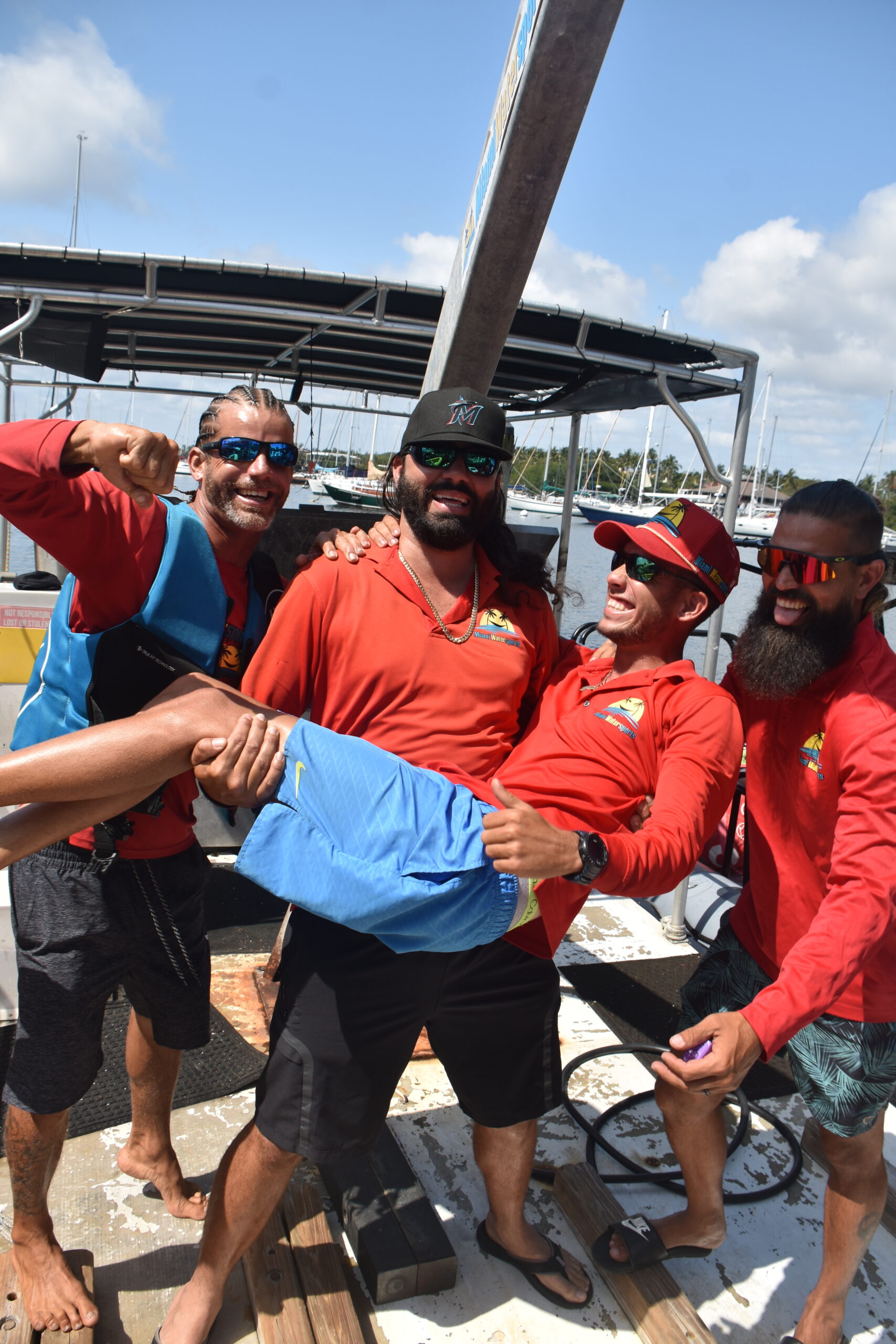
The Miami Watersports crew has run parasailing, jet ski, flyboard, and boat trips from Pier 9 at Dinner Key Marina in Coconut Grove since 2007.